

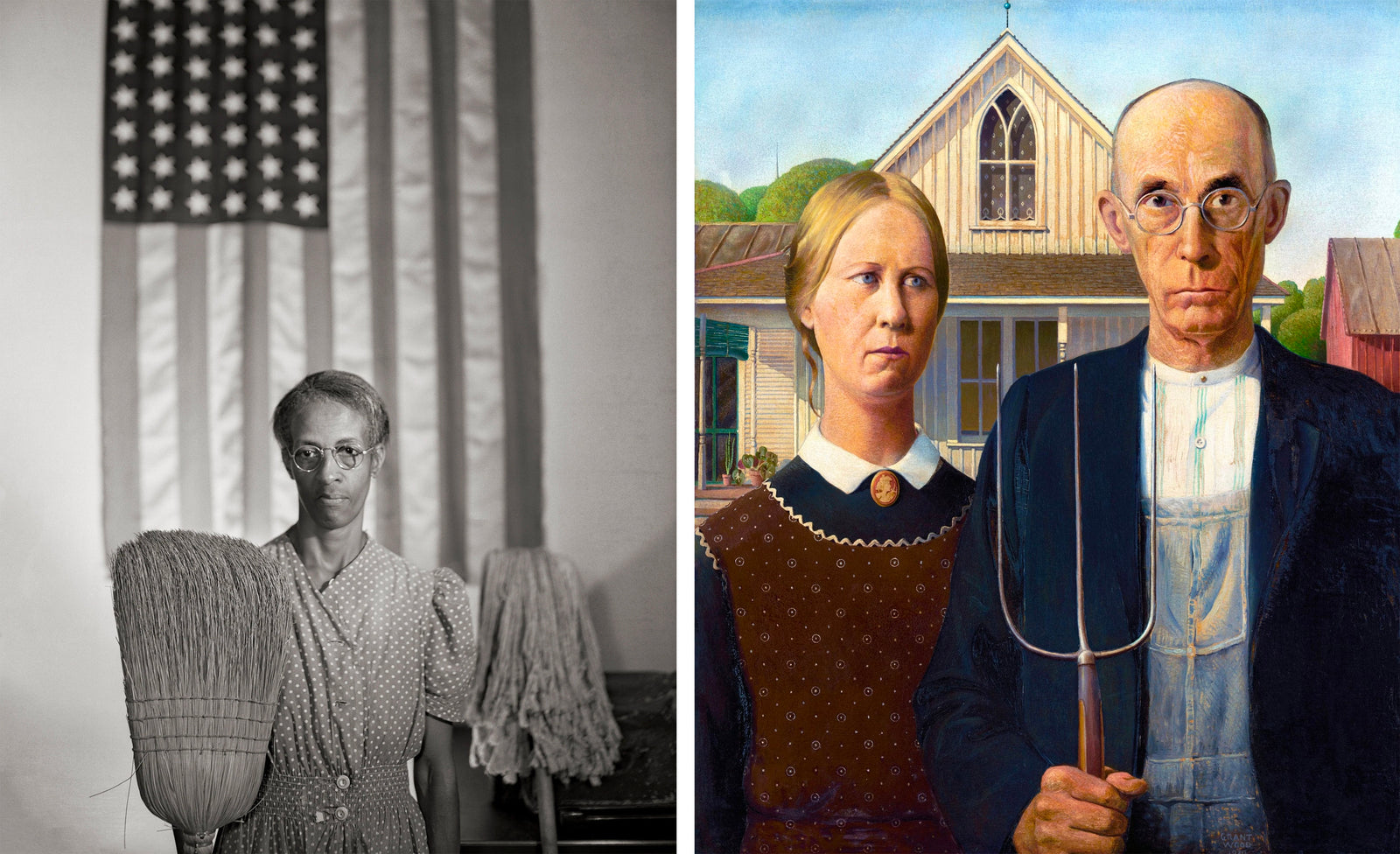
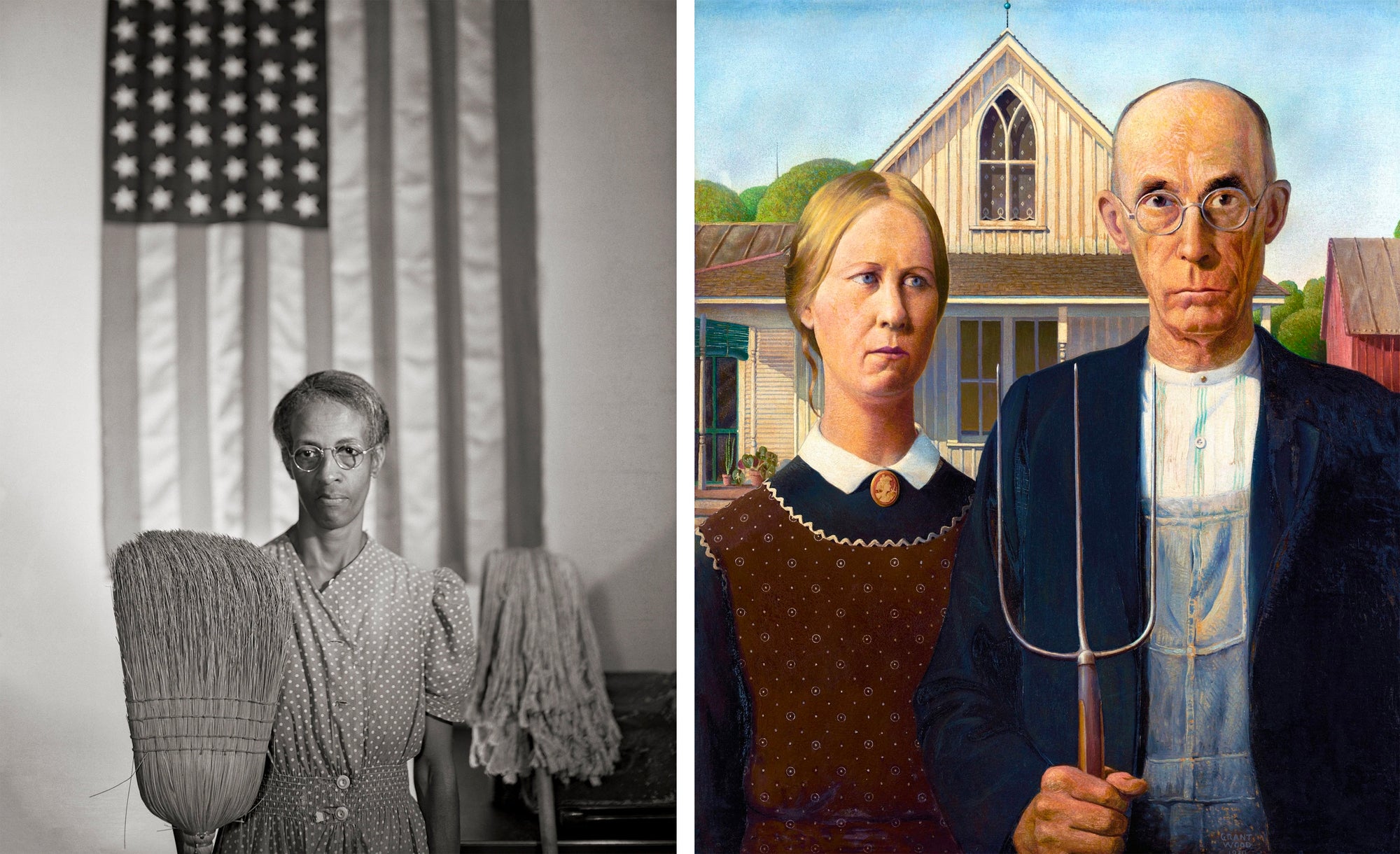
Dual Perspectives: 'American Gothic' - Grant Wood's Painting and Gordon Parks Photo
Both Grant Wood's painting "American Gothic" and Gordon Parks' photograph of the same name draw upon the idea of American identity, but they offer contrasting perspectives that speak to different times and contexts.
Grant Wood's "American Gothic," painted in 1930, is an iconic image featuring a stern-looking farmer holding a pitchfork and a woman beside him, standing in front of a Gothic-style house. The painting has been widely interpreted but is often seen as a representation of American Midwestern values, stoicism, and hard work. The characters look serious, and there's something deeply traditional about the setting, from their clothing to the architectural style of the home. Wood's painting became symbolic of a certain kind of American experience, particularly the rural, hardworking life of the Midwest during the Great Depression.
On the other hand, Gordon Parks' "American Gothic" is a photograph taken in 1942 featuring Ella Watson, a black custodian in Washington, D.C., standing in front of an American flag with a broom and a mop. Parks' photograph was a direct response to Wood's painting but presented a contrasting narrative. The image is a critique of racial segregation and the limited opportunities available to African Americans, even in the nation's capital. It starkly addresses the racial inequality that coexisted with the American ideals symbolized by the flag in the background.
While Wood's "American Gothic" is often seen as capturing the essence of the American experience, Parks' "American Gothic" challenges that narrative by asking who gets to be included in that experience. Parks brings into the frame the systemic injustices and struggles that were often overlooked or deliberately ignored in mainstream depictions of American life. The somber expression on Ella Watson's face echoes the sternness of the figures in Wood's painting, but in her case, it reflects not just hard work but also the weight of social inequality.
In summary, both works use similar elements, such as a serious tone and iconic American symbols, but to different ends. Grant Wood's painting often evokes a sense of nostalgia for a bygone era and set of values. In contrast, Gordon Parks' photograph serves as a social critique, challenging the viewer to reconcile the American ideals with the stark realities faced by marginalized communities. Both are compelling in their own right, but they offer divergent viewpoints on what the "American Gothic" truly represents.
Grant Wood's "American Gothic," painted in 1930, is an iconic image featuring a stern-looking farmer holding a pitchfork and a woman beside him, standing in front of a Gothic-style house. The painting has been widely interpreted but is often seen as a representation of American Midwestern values, stoicism, and hard work. The characters look serious, and there's something deeply traditional about the setting, from their clothing to the architectural style of the home. Wood's painting became symbolic of a certain kind of American experience, particularly the rural, hardworking life of the Midwest during the Great Depression.
On the other hand, Gordon Parks' "American Gothic" is a photograph taken in 1942 featuring Ella Watson, a black custodian in Washington, D.C., standing in front of an American flag with a broom and a mop. Parks' photograph was a direct response to Wood's painting but presented a contrasting narrative. The image is a critique of racial segregation and the limited opportunities available to African Americans, even in the nation's capital. It starkly addresses the racial inequality that coexisted with the American ideals symbolized by the flag in the background.
While Wood's "American Gothic" is often seen as capturing the essence of the American experience, Parks' "American Gothic" challenges that narrative by asking who gets to be included in that experience. Parks brings into the frame the systemic injustices and struggles that were often overlooked or deliberately ignored in mainstream depictions of American life. The somber expression on Ella Watson's face echoes the sternness of the figures in Wood's painting, but in her case, it reflects not just hard work but also the weight of social inequality.
In summary, both works use similar elements, such as a serious tone and iconic American symbols, but to different ends. Grant Wood's painting often evokes a sense of nostalgia for a bygone era and set of values. In contrast, Gordon Parks' photograph serves as a social critique, challenging the viewer to reconcile the American ideals with the stark realities faced by marginalized communities. Both are compelling in their own right, but they offer divergent viewpoints on what the "American Gothic" truly represents.
Leave a comment
Comments will be approved before showing up.
Also in Time Capsule


Six New York Landmarks That Changed the Manhattan Skyline
New York's skyline wasn't built overnight. Vintage photographs of Trinity Church, the Plaza, Waldorf-Astoria, Chrysler Building, Empire State Building and Rockefeller Center reveal how Manhattan grew from a city of church steeples and grand hotels into the skyscraper capital of the world.



The Old West Never Really Ended
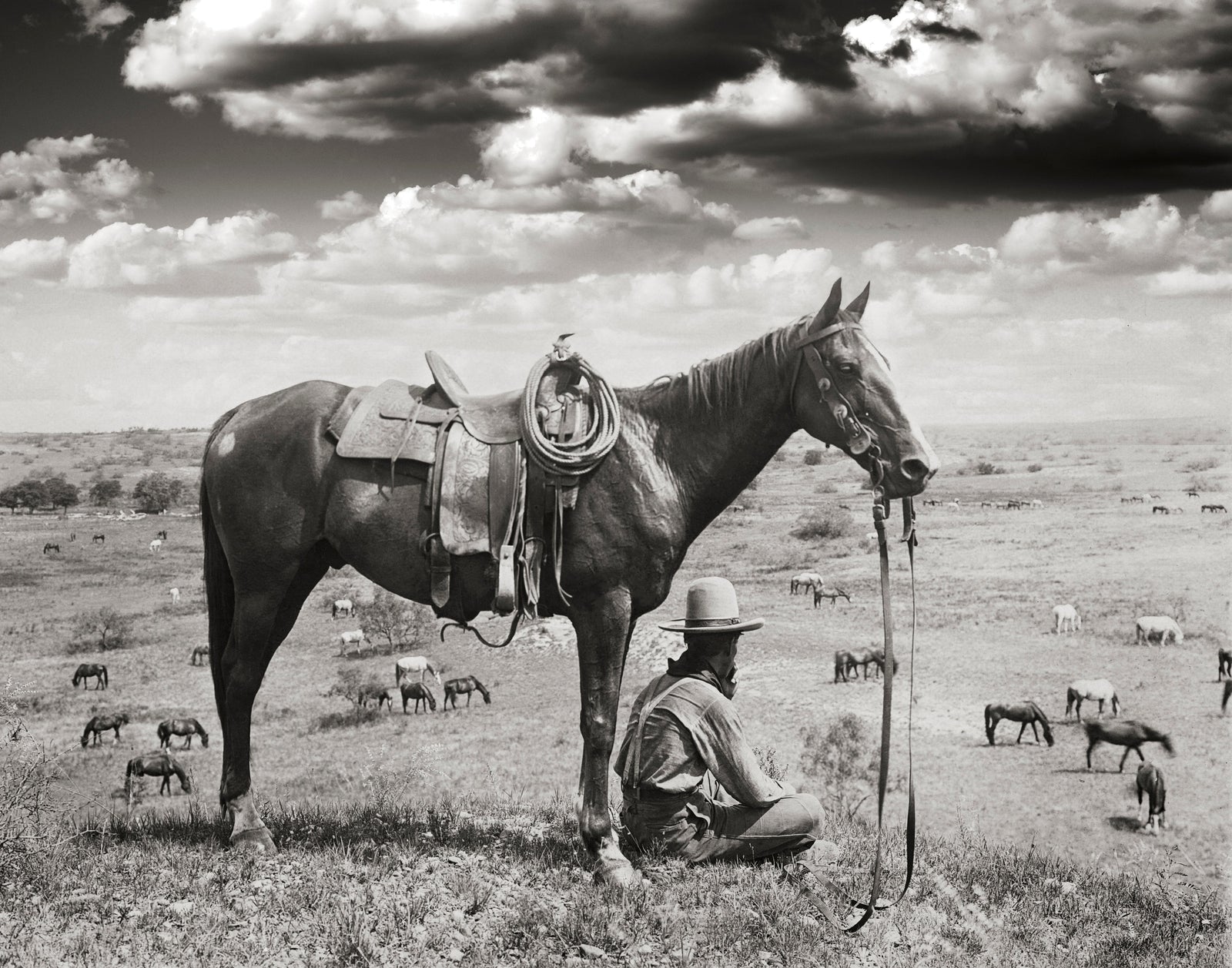
A cowboy on horseback overlooks the Dallas skyline in 1943—an image that seems to capture the Old West and modern America in a single frame. But the cowboy didn't disappear when the frontier closed. Discover how real working cowboys, rodeos, music and Hollywood carried the Old West into the 20th century.
Let customers speak for us
Gems
These short clips are gems. They are part of the history of music in America. Thank you for posting.
S. Kelley Chambers

Love the print and perfect decor for our n...
Love the print and perfect decor for our new apartment in Pittsburgh.
Chris P

5 stars review from Laura
5 stars review from Laura
Laura D

5 stars review from Geri
5 stars review from Geri
Geri L

5 stars review from Stephanie
5 stars review from Stephanie
Stephanie

5 stars review from Brookelynz
5 stars review from Brookelynz
Brookelynz
5 stars review from Deborah
5 stars review from Deborah
Deborah G

Spectacular!
Received as a gift and could not be happier with the quality of the print. Shipping container ensure this arrived in perfect condition.
John

5 stars review from Kayla
5 stars review from Kayla
Kayla G

5 stars review from Blondiee
5 stars review from Blondiee
Blondiee

5 stars review from April
5 stars review from April
April Y

5 stars review from Tracie
5 stars review from Tracie
Tracie C

Great quality and fast delivery!
Great quality and fast delivery!
Amanda C

5 stars review from Autumnrayne4
5 stars review from Autumnrayne4
Autumnrayne4

5 stars review from Traca
5 stars review from Traca
Traca B
