


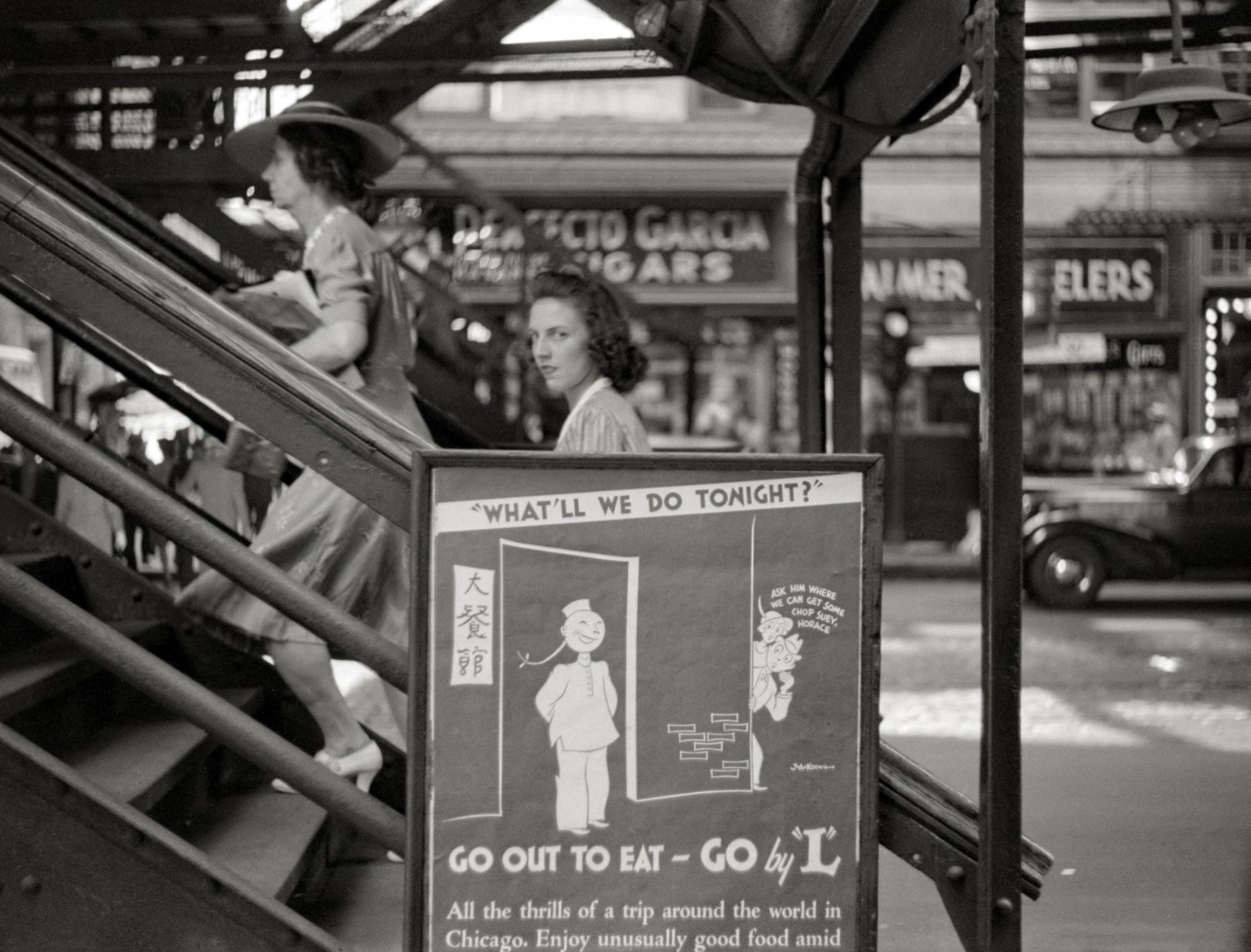


Chicago El Train Photo, John Vachon, 1941
$35.50 - $158.00
Step into the bustling city of Chicago with this captivating photograph. Taken during the early years of the iconic "L" train, it captures a woman gracefully ascending the elevated platform. Her gaze meets the camera, revealing a glimpse of the vibrant energy that defined the city's transportation system. Just below her, an intriguing advertisement beckons with the question, "What'll we do tonight?" The answer is clear - embark on a culinary adventure by taking the "L" to discover the city's vibrant dining scene. This historic image offers a fascinating snapshot of Chicago's rich heritage and the integral role played by the "L" in shaping the city's growth and culture.
Construction on the first section of the "L" began in 1892, and the first train ran on June 6, 1892, between Congress Street and 39th Street. Over the next few years, additional lines were constructed, and by the turn of the century, the system had expanded to cover much of the city's downtown and outlying areas.
In the early days, the "L" was powered by steam locomotives, which proved to be noisy and polluting. In 1897, the system began to switch to electric power, and by the early 20th century, all of the "L" trains were powered by electricity.
Throughout the early 20th century, the "L" continued to expand, with new lines being added to the system and existing lines being extended. By the 1920s, the "L" had become a vital part of Chicago's transportation network, carrying millions of passengers each year.
In the decades that followed, the "L" faced challenges, including declining ridership, budget cuts, and maintenance issues. However, the system continued to serve the city and underwent major renovations in the 1980s and 1990s.
Construction on the first section of the "L" began in 1892, and the first train ran on June 6, 1892, between Congress Street and 39th Street. Over the next few years, additional lines were constructed, and by the turn of the century, the system had expanded to cover much of the city's downtown and outlying areas.
In the early days, the "L" was powered by steam locomotives, which proved to be noisy and polluting. In 1897, the system began to switch to electric power, and by the early 20th century, all of the "L" trains were powered by electricity.
Throughout the early 20th century, the "L" continued to expand, with new lines being added to the system and existing lines being extended. By the 1920s, the "L" had become a vital part of Chicago's transportation network, carrying millions of passengers each year.
In the decades that followed, the "L" faced challenges, including declining ridership, budget cuts, and maintenance issues. However, the system continued to serve the city and underwent major renovations in the 1980s and 1990s.