
Dual Perspectives: 'American Gothic' - Grant Wood's Painting and Gordon Parks Photo
Both Grant Wood's painting "American Gothic" and Gordon Parks' photograph of the same name draw upon the idea of American identity, but they offer contrasting perspectives that speak to different times and contexts.
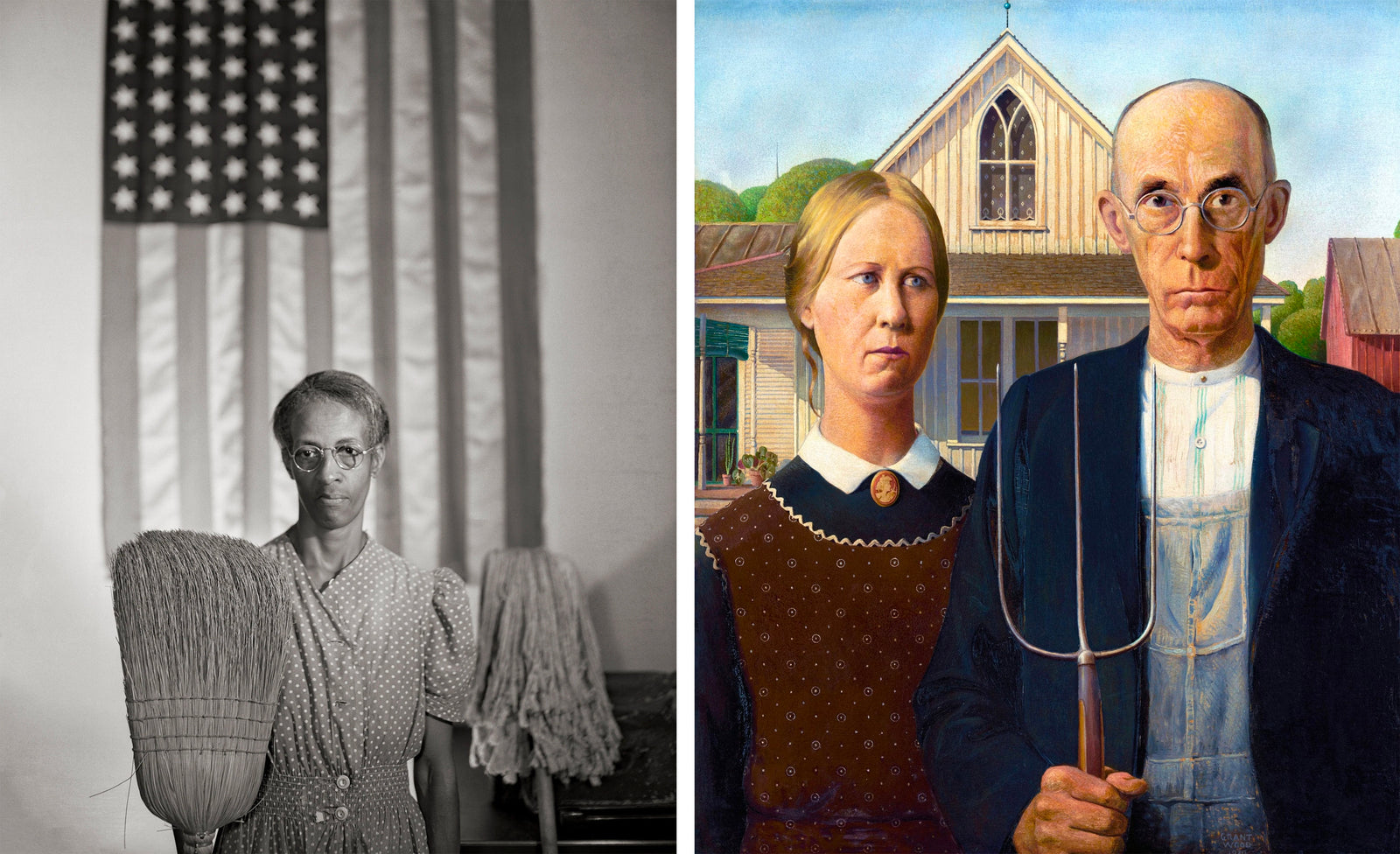
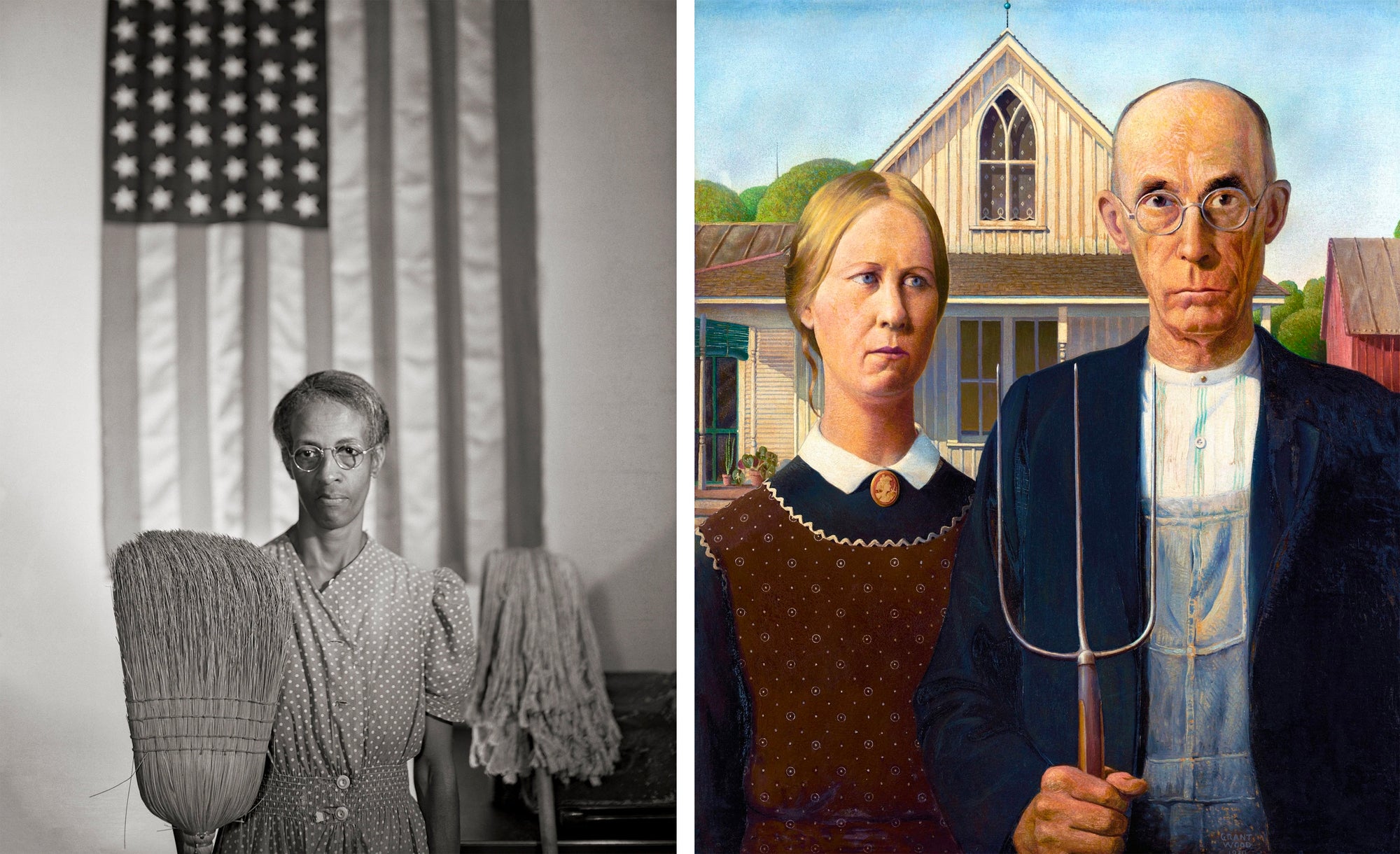
Grant Wood's "American Gothic," painted in 1930, is an iconic image featuring a stern-looking farmer holding a pitchfork and a woman beside him, standing in front of a Gothic-style house. The painting has been widely interpreted but is often seen as a representation of American Midwestern values, stoicism, and hard work. The characters look serious, and there's something deeply traditional about the setting, from their clothing to the architectural style of the home. Wood's painting became symbolic of a certain kind of American experience, particularly the rural, hardworking life of the Midwest during the Great Depression.
On the other hand, Gordon Parks' "American Gothic" is a photograph taken in 1942 featuring Ella Watson, a black custodian in Washington, D.C., standing in front of an American flag with a broom and a mop. Parks' photograph was a direct response to Wood's painting but presented a contrasting narrative. The image is a critique of racial segregation and the limited opportunities available to African Americans, even in the nation's capital. It starkly addresses the racial inequality that coexisted with the American ideals symbolized by the flag in the background.
While Wood's "American Gothic" is often seen as capturing the essence of the American experience, Parks' "American Gothic" challenges that narrative by asking who gets to be included in that experience. Parks brings into the frame the systemic injustices and struggles that were often overlooked or deliberately ignored in mainstream depictions of American life. The somber expression on Ella Watson's face echoes the sternness of the figures in Wood's painting, but in her case, it reflects not just hard work but also the weight of social inequality.
In summary, both works use similar elements, such as a serious tone and iconic American symbols, but to different ends. Grant Wood's painting often evokes a sense of nostalgia for a bygone era and set of values. In contrast, Gordon Parks' photograph serves as a social critique, challenging the viewer to reconcile the American ideals with the stark realities faced by marginalized communities. Both are compelling in their own right, but they offer divergent viewpoints on what the "American Gothic" truly represents.
Grant Wood's "American Gothic," painted in 1930, is an iconic image featuring a stern-looking farmer holding a pitchfork and a woman beside him, standing in front of a Gothic-style house. The painting has been widely interpreted but is often seen as a representation of American Midwestern values, stoicism, and hard work. The characters look serious, and there's something deeply traditional about the setting, from their clothing to the architectural style of the home. Wood's painting became symbolic of a certain kind of American experience, particularly the rural, hardworking life of the Midwest during the Great Depression.
On the other hand, Gordon Parks' "American Gothic" is a photograph taken in 1942 featuring Ella Watson, a black custodian in Washington, D.C., standing in front of an American flag with a broom and a mop. Parks' photograph was a direct response to Wood's painting but presented a contrasting narrative. The image is a critique of racial segregation and the limited opportunities available to African Americans, even in the nation's capital. It starkly addresses the racial inequality that coexisted with the American ideals symbolized by the flag in the background.
While Wood's "American Gothic" is often seen as capturing the essence of the American experience, Parks' "American Gothic" challenges that narrative by asking who gets to be included in that experience. Parks brings into the frame the systemic injustices and struggles that were often overlooked or deliberately ignored in mainstream depictions of American life. The somber expression on Ella Watson's face echoes the sternness of the figures in Wood's painting, but in her case, it reflects not just hard work but also the weight of social inequality.
In summary, both works use similar elements, such as a serious tone and iconic American symbols, but to different ends. Grant Wood's painting often evokes a sense of nostalgia for a bygone era and set of values. In contrast, Gordon Parks' photograph serves as a social critique, challenging the viewer to reconcile the American ideals with the stark realities faced by marginalized communities. Both are compelling in their own right, but they offer divergent viewpoints on what the "American Gothic" truly represents.
Leave a comment
Comments will be approved before showing up.
Also in Time Capsule





The Birth of a Floating Dream: Building the Titanic
In the years since its sinking, Titanic has become a symbol of both human achievement and human fallibility. Its construction remains a subject of fascination, not only for the scale of the project, but for what it reveals about the values and priorities of the time. The ship was built with extraordinary care and expertise, yet it was also shaped by assumptions that would ultimately prove flawed.
Let customers speak for us
Love the print and perfect decor for our n...
Love the print and perfect decor for our new apartment in Pittsburgh.
Chris P

Pittsburgh, Pennsylvania, Mill District, Man Going To Work, 1940

5 stars review from Geri
5 stars review from Geri
Geri L

New England Fishing Schooner and Sailboat, 1907
5 stars review from Stephanie
5 stars review from Stephanie
Stephanie

Suffragettes Protesting, Women's March 1913 Program Cover
5 stars review from Deborah
5 stars review from Deborah
Deborah G

African American Girls Photo, St. Louis Missouri, 1940
Spectacular!
Received as a gift and could not be happier with the quality of the print. Shipping container ensure this arrived in perfect condition.
John

Pilgrim Monument, Provincetown, Barnstable County, MA, Summer, 1937
5 stars review from Kayla
5 stars review from Kayla
Kayla G

Four Messenger Girls, Western Union, Washington DC, 1925
5 stars review from Blondiee
5 stars review from Blondiee
Blondiee

Suffragettes On Their Way to Boston, Flanked by Men, Early 1900s
5 stars review from April
5 stars review from April
April Y

New York City, City Hall Subway Station, 1901
5 stars review from Tracie
5 stars review from Tracie
Tracie C

Las Vegas Motel Yucca and Little Chapel of the Flowers
Great quality and fast delivery!
Great quality and fast delivery!
Amanda C

Dallas Texas Skyline, Cowboy & Horse, Dallas Texas, 1943
5 stars review from Autumnrayne4
5 stars review from Autumnrayne4
Autumnrayne4

Painters on Brooklyn Bridge, Photo By Eugene de Salignac, NYC, 1914
5 stars review from Traca
5 stars review from Traca
Traca B

Shasta County, CA, "Eight Ball Pool Room," Photo, 1940s
I love it! It's beautiful! Thank you so mu...
I love it! It's beautiful! Thank you so much! Will definitely be ordering from this shop again!
Uuuhhhtash

Minneapolis Art, Foshay Tower Dedication, 1929