


Max Planck: The Scientist Who Opened the Door to Quantum Physics

A Quiet Revolutionary in Physics
Few scientific discoveries have reshaped humanity’s understanding of the universe as profoundly as quantum theory. At the center of that transformation stood Max Planck, a German scientist whose work at the beginning of the twentieth century forced physicists to rethink the fundamental nature of energy and matter.
Ironically, Planck did not set out to revolutionize physics. He was, by temperament, cautious and methodical. For much of his early career, he worked within the established traditions of classical physics, the framework developed by scientists such as Newton and Maxwell. Yet in attempting to solve a stubborn problem involving heat radiation, Planck introduced an idea so radical that it became the foundation of modern quantum mechanics.
That insight—that energy is emitted and absorbed in discrete packets rather than continuous waves—would eventually reshape physics, chemistry, and technology. Today it underlies everything from atomic science to the electronics inside smartphones.
Childhood and Early Education
Max Karl Ernst Ludwig Planck was born on April 23, 1858, in Kiel, Germany. His father was a respected law professor, and his family valued scholarship and intellectual discipline. When Planck was still young, the family moved to Munich, where he attended one of the city’s leading schools.
From an early age, Planck demonstrated strong academic ability, particularly in mathematics and science. He also possessed a deep love for music and was an accomplished pianist. Throughout his life he continued to play music regularly, finding in it both intellectual and emotional balance.
During his schooling, Planck encountered the laws of energy conservation and thermodynamics—concepts that would later become central to his research. One teacher reportedly told him that physics was nearly complete and that there were few major discoveries left to make. Planck ignored the advice and pursued the field anyway.
University Studies and Academic Career
Planck studied physics at the University of Munich and later at the University of Berlin, where he learned from some of the most respected scientists of the era. His early work focused on thermodynamics, the study of heat and energy transfer.
In 1885 he became a professor at the University of Kiel, and later he moved to Berlin, where he spent much of his career teaching and conducting research. At the time, Berlin was one of the leading centers of scientific activity in Europe.
Planck developed a reputation as a careful thinker who approached problems with patience and precision. He was deeply committed to understanding the mathematical principles underlying physical processes.
The Puzzle of Blackbody Radiation
At the end of the nineteenth century, physicists faced a perplexing problem involving blackbody radiation. A “blackbody” is an idealized object that absorbs all radiation and emits energy depending on its temperature. Scientists were attempting to determine how much energy such an object would emit at different wavelengths of light.
Classical physics could explain part of the behavior, but it failed dramatically at shorter wavelengths. According to existing theories, the energy emitted should increase infinitely at high frequencies—an obviously impossible result known as the “ultraviolet catastrophe.”
Physicists struggled to reconcile theory with experimental measurements.
Planck approached the problem reluctantly, hoping to find a solution that preserved classical physics. Instead, his calculations forced him toward an extraordinary conclusion.
The Birth of Quantum Theory
In 1900, Planck proposed that energy could not be emitted continuously but instead came in discrete units, which he called “quanta.” According to his theory, the energy of these packets depended on the frequency of radiation.
The relationship between energy and frequency became known as Planck’s constant, one of the most fundamental constants in physics.
This idea contradicted long-standing assumptions about the nature of energy. In classical physics, energy was thought to vary smoothly and continuously. Planck’s work suggested that at microscopic scales, nature behaved differently.
Initially, Planck himself regarded the concept as a mathematical trick rather than a fundamental law. But other scientists soon realized its deeper implications.
Influence on Einstein and Modern Physics
Planck’s discovery opened the door to a new era of physics. In 1905, Albert Einstein applied quantum ideas to explain the photoelectric effect, demonstrating that light itself could behave like discrete particles called photons.
Over the following decades, physicists such as Niels Bohr, Werner Heisenberg, and Erwin Schrödinger developed the full framework of quantum mechanics. Their work described how atoms, electrons, and other particles behave according to probabilistic laws that differ dramatically from classical expectations.
Although Planck had not anticipated the full revolution his idea would trigger, his work laid the essential foundation.
In recognition of his contributions, he received the Nobel Prize in Physics in 1918.
A Life Through Turbulent Times
Planck’s scientific career unfolded during a period of immense political upheaval in Germany. He lived through the collapse of the German Empire, the turmoil of World War I, the rise of the Nazi regime, and the devastation of World War II.
Unlike many scientists who emigrated during the Nazi era, Planck remained in Germany. His position as one of the country’s most respected scientists gave him a complicated role within the academic establishment.
Planck personally opposed many of the Nazi government’s policies, particularly the persecution of Jewish scientists. He attempted, with limited success, to protect colleagues who were dismissed or forced to flee.
The political climate made scientific work increasingly difficult. Many of Germany’s leading physicists left the country, weakening its research institutions.
Personal Tragedy
Planck’s later years were marked by profound personal loss. Several members of his family died during World War I and World War II. One of his sons was executed in 1945 after being implicated in a plot to assassinate Adolf Hitler.
These tragedies weighed heavily on Planck during his final years. Yet he continued to advocate for the importance of scientific inquiry and intellectual freedom even amid the destruction of war.
Final Years and Legacy
After World War II, Planck lived quietly in Germany as the country struggled to rebuild its institutions. He died in 1947 at the age of eighty-nine.
Today, Max Planck is remembered as one of the founders of modern physics. The scientific institute network in Germany known as the Max Planck Society bears his name and continues to conduct world-leading research in fields ranging from astrophysics to molecular biology.
Planck’s constant remains a central quantity in physics, appearing in equations that describe atomic behavior, particle interactions, and even the structure of the universe.
A Discovery That Changed Reality
What makes Planck’s work so remarkable is that it began as a modest attempt to solve a technical problem in thermodynamics. Yet the solution revealed that the underlying structure of reality was far stranger than anyone had imagined.
Energy, light, and matter behave in ways that defy everyday intuition. The quantum world operates through probabilities, discrete states, and interactions that challenge classical ideas of cause and effect.
Planck himself once remarked that new scientific truths often triumph not because opponents become convinced, but because a new generation grows up familiar with them.
His discovery exemplified that idea. What began as a controversial hypothesis eventually became one of the cornerstones of modern science.
More than a century after his breakthrough, the quantum theory that Planck helped initiate continues to guide humanity’s exploration of the smallest structures of the universe and the technologies that shape modern life. See his photo.
Leave a comment
Comments will be approved before showing up.
Also in Time Capsule
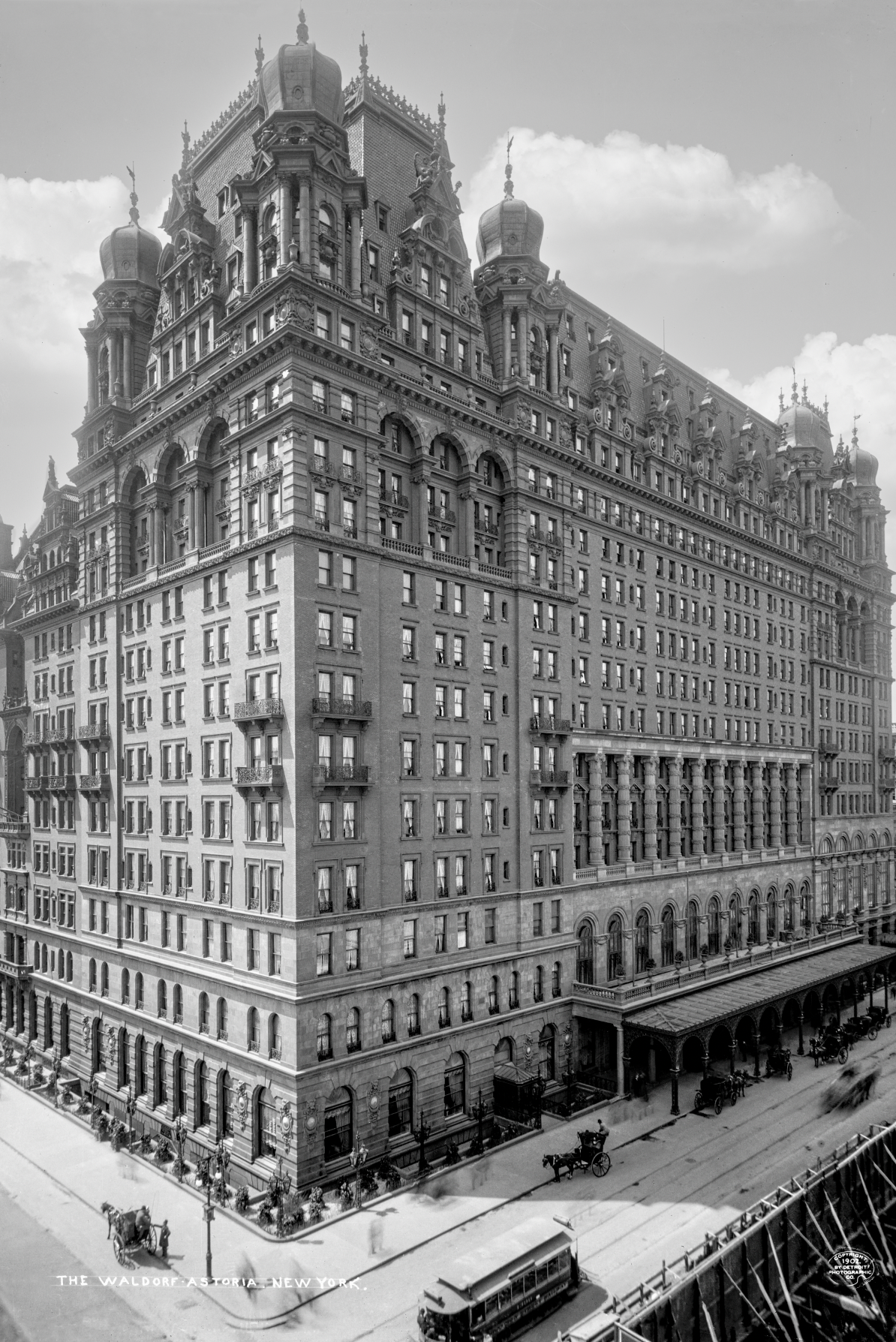

Six New York Landmarks That Changed the Manhattan Skyline
New York's skyline wasn't built overnight. Vintage photographs of Trinity Church, the Plaza, Waldorf-Astoria, Chrysler Building, Empire State Building and Rockefeller Center reveal how Manhattan grew from a city of church steeples and grand hotels into the skyscraper capital of the world.



The Old West Never Really Ended
A cowboy on horseback overlooks the Dallas skyline in 1943—an image that seems to capture the Old West and modern America in a single frame. But the cowboy didn't disappear when the frontier closed. Discover how real working cowboys, rodeos, music and Hollywood carried the Old West into the 20th century.
Let customers speak for us
Gems
These short clips are gems. They are part of the history of music in America. Thank you for posting.
S. Kelley Chambers

Love the print and perfect decor for our n...
Love the print and perfect decor for our new apartment in Pittsburgh.
Chris P

5 stars review from Laura
5 stars review from Laura
Laura D

5 stars review from Geri
5 stars review from Geri
Geri L

5 stars review from Stephanie
5 stars review from Stephanie
Stephanie

5 stars review from Brookelynz
5 stars review from Brookelynz
Brookelynz
5 stars review from Deborah
5 stars review from Deborah
Deborah G

Spectacular!
Received as a gift and could not be happier with the quality of the print. Shipping container ensure this arrived in perfect condition.
John

5 stars review from Kayla
5 stars review from Kayla
Kayla G

5 stars review from Blondiee
5 stars review from Blondiee
Blondiee

5 stars review from April
5 stars review from April
April Y

5 stars review from Tracie
5 stars review from Tracie
Tracie C

Great quality and fast delivery!
Great quality and fast delivery!
Amanda C

5 stars review from Autumnrayne4
5 stars review from Autumnrayne4
Autumnrayne4

5 stars review from Traca
5 stars review from Traca
Traca B
