


Nikola Tesla: The Visionary Who Imagined the Electrical Age

A Mind Far Ahead of Its Time
Few figures in the history of science and technology have captured the imagination of the public quite like Nikola Tesla. Inventor, engineer, and visionary, Tesla helped shape the electrical systems that power the modern world. Yet during his lifetime he often struggled financially and received far less recognition than many of his contemporaries. His life was a mixture of brilliance, ambition, rivalry, and, ultimately, solitude.
Today Tesla is remembered as one of the most innovative thinkers of the late nineteenth and early twentieth centuries. His work on alternating current electricity transformed the way power could be generated and transmitted across long distances, making large-scale electrification possible. Without Tesla’s contributions, the electrical infrastructure that defines modern civilization—from power grids to motors—would look very different.
Yet Tesla’s story is not only about invention. It is also about imagination. He envisioned wireless communication, global transmission of information, and technologies that would not appear until decades after his death.
Childhood in the Balkans
Nikola Tesla was born on July 10, 1856, in the village of Smiljan, which was then part of the Austrian Empire (today located in Croatia). His father, Milutin Tesla, was a Serbian Orthodox priest, while his mother, Đuka Mandić, came from a family known for mechanical ingenuity. Although she had no formal education, she created household tools and devices, and Tesla later credited her with inspiring his own inventive spirit.
As a child, Tesla displayed an extraordinary memory and an unusual ability to visualize complex mechanisms in his mind. He could imagine machines in precise detail, mentally testing their operation before ever constructing them physically. This capacity for visualization became one of his defining intellectual traits.
Tesla also experienced intense sensory perceptions. Bright flashes of light and vivid mental images accompanied many of his thoughts. Though unsettling at times, these sensations may have contributed to his creative thinking.
Education and Early Engineering Work
Tesla studied engineering and physics at the Austrian Polytechnic in Graz during the 1870s. Although he showed remarkable aptitude, his academic career was uneven, and he eventually left the institution without completing a degree. He later attended lectures at Charles-Ferdinand University in Prague but again did not finish formal studies.
Despite this, Tesla possessed an exceptional understanding of electrical principles. By the early 1880s he was working as an electrical engineer in Budapest, where he made one of his most important conceptual breakthroughs: the rotating magnetic field.
This insight would become the foundation of alternating current (AC) motors.
The Journey to America
In 1884 Tesla immigrated to the United States, arriving in New York with little money but carrying a letter of introduction to the famous inventor Thomas Edison. Edison had already become a central figure in the electrical industry, promoting his system of direct current (DC) power generation.
Tesla briefly worked for Edison, improving electrical equipment and systems. However, the two men soon clashed. Edison’s DC system required power stations every mile or so because electricity could not be transmitted efficiently over long distances. Tesla believed alternating current offered a far superior solution.
AC electricity could travel much farther and be transformed to different voltages using transformers, making it practical for large-scale distribution.
Their disagreement became part of what later historians called the “War of Currents.”
The War of Currents
The conflict between direct current and alternating current systems became one of the most famous technological rivalries in history. Edison promoted DC as safer and more reliable, while Tesla and his business partner George Westinghouse championed AC.
Westinghouse recognized the potential of Tesla’s patents and purchased the rights to his AC motor designs. Together they began building electrical systems capable of transmitting power across long distances.
Edison’s companies responded with aggressive campaigns to discredit AC power, even staging demonstrations intended to portray it as dangerous. Despite these efforts, the efficiency of AC systems proved decisive.
A major victory came in 1893 when the AC system powered the World’s Columbian Exposition in Chicago, illuminating the fairgrounds with thousands of electric lights. Soon afterward, Tesla’s technology helped generate electricity at Niagara Falls, transmitting power to cities miles away.
The triumph of alternating current established the foundation of modern electrical grids.
Experiments with High Voltage
Tesla was not satisfied merely with improving electrical infrastructure. His curiosity pushed him toward increasingly dramatic experiments with high-frequency and high-voltage electricity. In his laboratories he built massive coils capable of producing spectacular electrical discharges.
These devices, now known as Tesla coils, generated arcs of electricity that could extend several feet through the air. Tesla often used them in public demonstrations to illustrate the behavior of electrical energy.
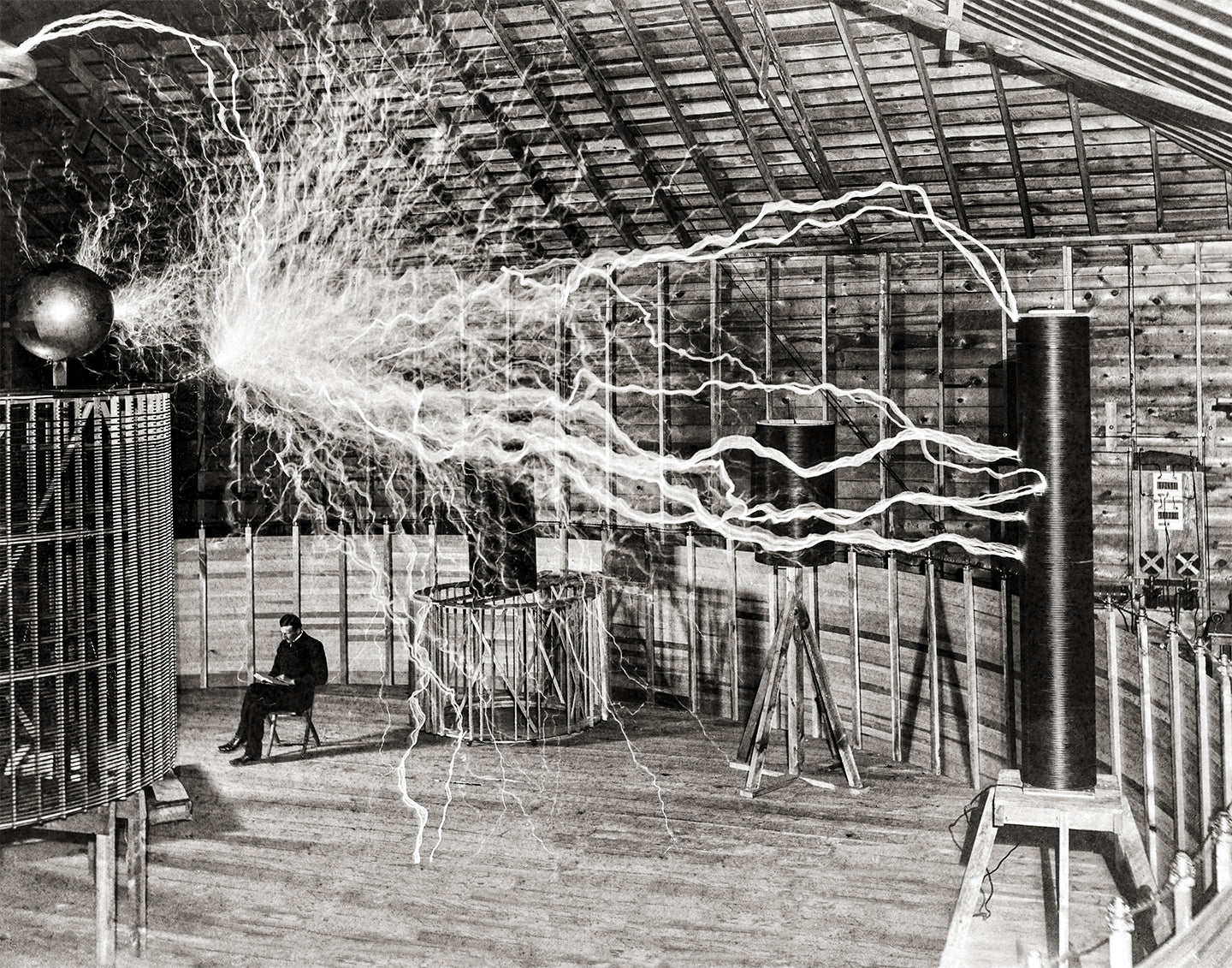
The famous photograph of Tesla sitting calmly in his Colorado Springs laboratory while enormous electrical arcs surround him comes from this period of experimentation. The image, which appears almost surreal, symbolized his reputation as a master of electrical forces.
Although the photograph was actually a composite image created for dramatic effect, it captured the spirit of Tesla’s work—bold, theatrical, and deeply experimental.
Colorado Springs Experiments
In 1899 Tesla established an experimental laboratory in Colorado Springs, where he conducted some of the most ambitious electrical experiments of his career. The region’s high altitude and open landscape provided ideal conditions for testing high-voltage transmission.
There Tesla built a giant coil capable of generating enormous electrical arcs. Witnesses reported bolts of artificial lightning stretching more than 100 feet. During one experiment, the apparatus reportedly overloaded the local power station, plunging the town into darkness.
Tesla’s goal was to explore the possibility of transmitting electrical power wirelessly through the Earth and atmosphere. He believed the planet itself could act as a conductor for electrical energy.
Although these experiments produced spectacular results, the practical realization of global wireless power remained elusive.
The Dream of Wireless Communication
Tesla’s most ambitious project emerged in the early 1900s with the construction of Wardenclyffe Tower on Long Island, New York. This massive structure was intended to serve as a wireless transmission station capable of sending both electrical power and communication signals across the globe.
Tesla envisioned a system that would allow information, images, and messages to be transmitted instantly between continents. In many ways, his concept anticipated technologies such as radio broadcasting and even elements of modern wireless communication networks.
Financing the project proved difficult. Tesla initially secured funding from the powerful banker J. P. Morgan, but when costs escalated and the technical challenges mounted, Morgan withdrew support. Without sufficient capital, the Wardenclyffe project stalled.
Eventually the unfinished tower was dismantled.
Rivalry and Recognition
While Tesla pursued ambitious experimental projects, other inventors were achieving commercial success. Among them was Guglielmo Marconi, whose radio communication system gained widespread recognition.
Marconi’s work built upon many earlier electrical discoveries, including ideas pioneered by Tesla. For years, Marconi was credited with inventing radio. Decades later, the United States Supreme Court acknowledged that Tesla’s earlier patents had priority in several key aspects of radio technology.
Despite these achievements, Tesla’s reputation during his later years faded compared to more commercially successful inventors.
Later Years and Isolation
In the early decades of the twentieth century Tesla continued proposing bold technological ideas. He spoke of wireless energy transmission, remote-controlled machines, and advanced electrical devices that could revolutionize industry and defense.
However, many of these concepts remained theoretical. Without strong financial backing, Tesla struggled to develop them into practical systems.
He spent his later years living in New York hotels, working on new ideas but increasingly removed from mainstream engineering circles. Friends and admirers still recognized his brilliance, but the world’s attention had shifted to other innovators.
Tesla developed a deep affection for pigeons, feeding them in city parks and even caring for injured birds in his hotel room. His eccentric habits became part of the legend surrounding him.

Death and Rediscovery
Nikola Tesla died on January 7, 1943, in a hotel room in New York City. He was eighty-six years old. At the time of his death, he was largely forgotten by the public.
In the decades that followed, however, interest in Tesla’s life and inventions grew dramatically. Engineers, historians, and scientists began reexamining his contributions to electrical engineering and wireless technology.
Today Tesla is widely recognized as one of the key pioneers of modern electrical science. His alternating current system remains the backbone of power distribution worldwide.
A Legacy That Powers the Modern World
Tesla’s work continues to influence modern technology. Electric motors, transformers, wireless communication systems, and countless other devices rely on principles he helped develop.
Beyond specific inventions, Tesla represents a particular kind of scientific imagination—one that blends engineering precision with visionary thinking. He saw possibilities in electricity that few others could imagine.
For this reason, his name has become synonymous with innovation. Laboratories, research centers, and even companies bear his name today.
More than a century after he conducted his experiments with crackling electrical arcs, Nikola Tesla remains a symbol of the creative mind pushing beyond the limits of the known world.
The Man Behind the Lightning
The image of Tesla sitting calmly as lightning-like discharges surround him has become one of the most iconic photographs in the history of science. Whether seen as dramatic symbolism or scientific theater, it captures the essence of the man himself.
Tesla was not simply experimenting with electricity. He was trying to reshape humanity’s relationship with energy, communication, and technology.
In many ways, the electrical age he envisioned is the world we now inhabit. See Tesla's famout photo.
Leave a comment
Comments will be approved before showing up.
Also in Time Capsule

Six New York Landmarks That Changed the Manhattan Skyline
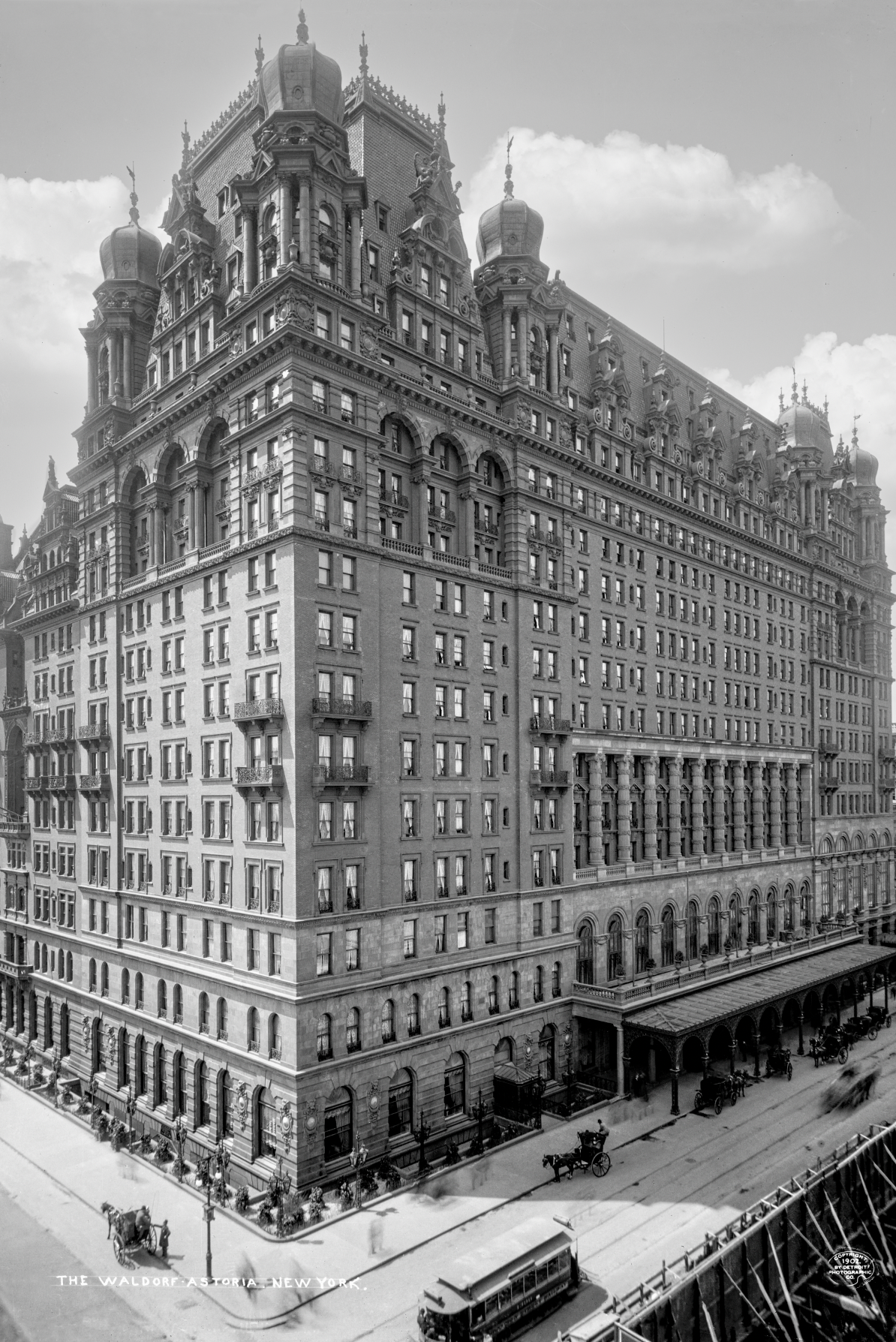
New York's skyline wasn't built overnight. Vintage photographs of Trinity Church, the Plaza, Waldorf-Astoria, Chrysler Building, Empire State Building and Rockefeller Center reveal how Manhattan grew from a city of church steeples and grand hotels into the skyscraper capital of the world.


The Old West Never Really Ended
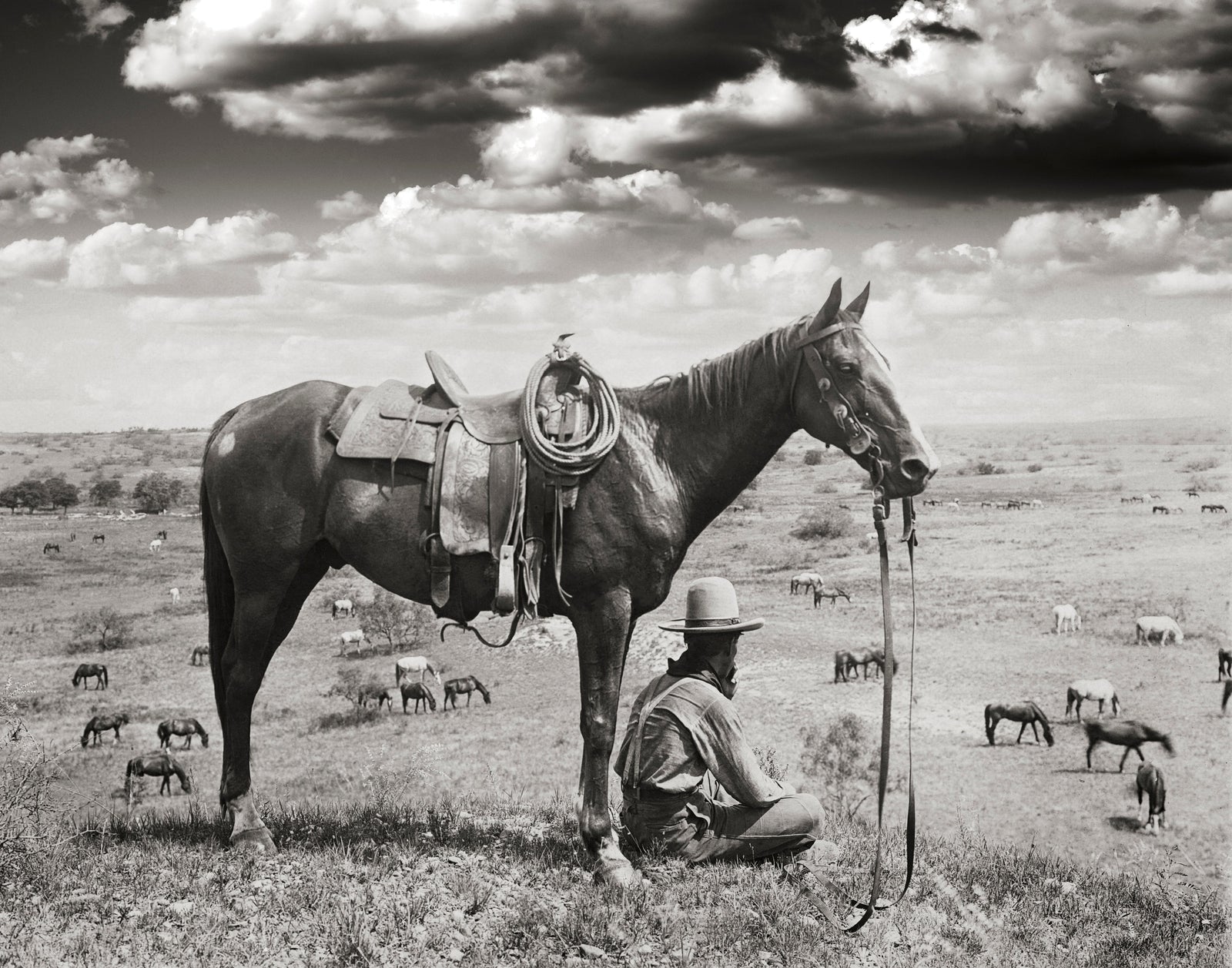
A cowboy on horseback overlooks the Dallas skyline in 1943—an image that seems to capture the Old West and modern America in a single frame. But the cowboy didn't disappear when the frontier closed. Discover how real working cowboys, rodeos, music and Hollywood carried the Old West into the 20th century.
Let customers speak for us
Gems
These short clips are gems. They are part of the history of music in America. Thank you for posting.
S. Kelley Chambers

Love the print and perfect decor for our n...
Love the print and perfect decor for our new apartment in Pittsburgh.
Chris P

5 stars review from Laura
5 stars review from Laura
Laura D

5 stars review from Geri
5 stars review from Geri
Geri L

5 stars review from Stephanie
5 stars review from Stephanie
Stephanie

5 stars review from Brookelynz
5 stars review from Brookelynz
Brookelynz
5 stars review from Deborah
5 stars review from Deborah
Deborah G

Spectacular!
Received as a gift and could not be happier with the quality of the print. Shipping container ensure this arrived in perfect condition.
John

5 stars review from Kayla
5 stars review from Kayla
Kayla G

5 stars review from Blondiee
5 stars review from Blondiee
Blondiee

5 stars review from April
5 stars review from April
April Y

5 stars review from Tracie
5 stars review from Tracie
Tracie C

Great quality and fast delivery!
Great quality and fast delivery!
Amanda C

5 stars review from Autumnrayne4
5 stars review from Autumnrayne4
Autumnrayne4

5 stars review from Traca
5 stars review from Traca
Traca B
