

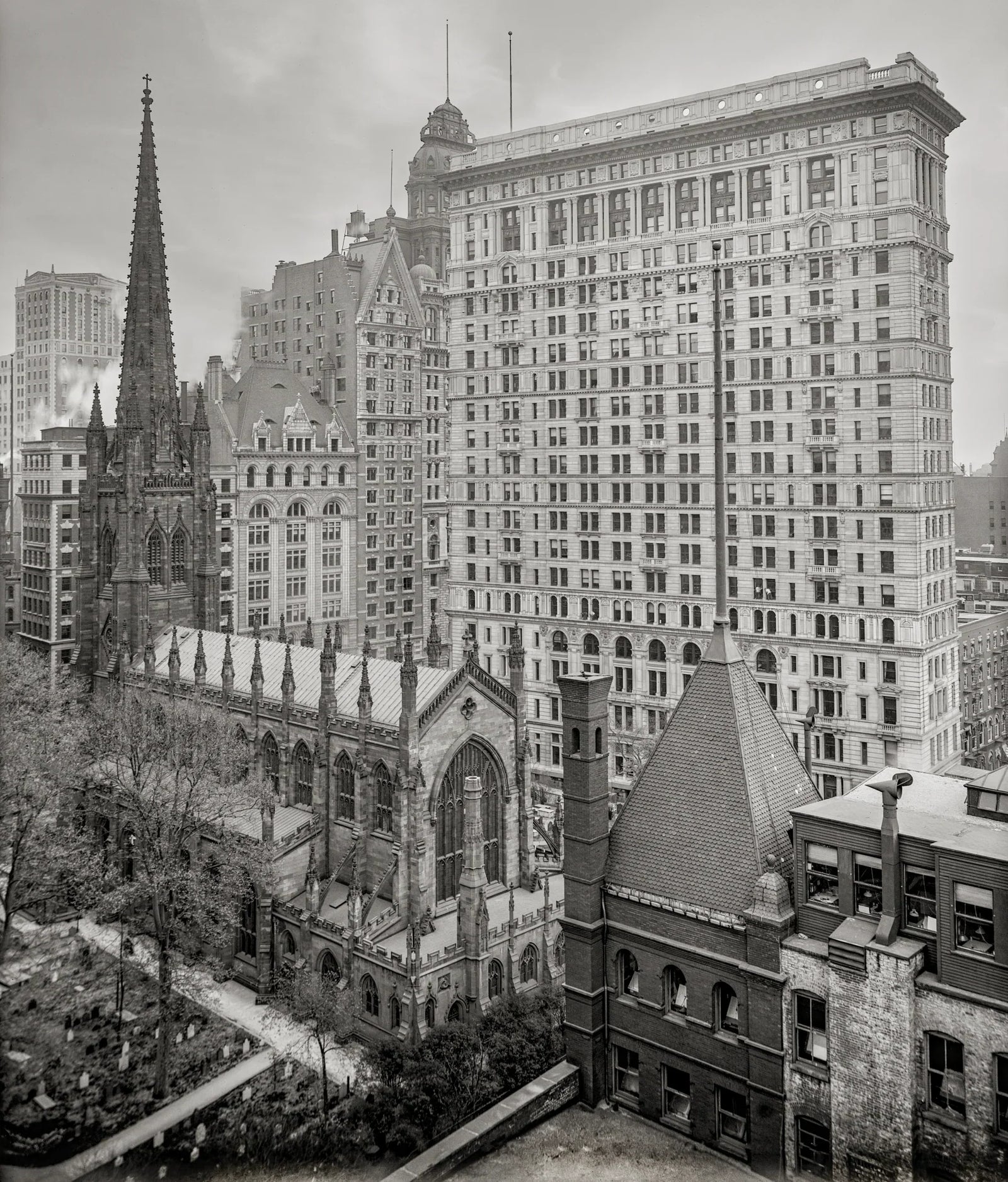

Trinity Church: Faith, Fire, Fortune, and the Making of Wall Street
At the head of Wall Street, where finance now hums and glass towers catch the light, Trinity Church stands in deliberate contrast—brownstone, Gothic, and rooted. It is older than the New York Stock Exchange, older than the skyscrapers, older even than the nation whose financial heart now beats at its door. Trinity’s history is not ornamental; it is woven into the story of colonial ambition, revolution, immigration, wealth, and reform.
A Royal Beginning in a Colonial Outpost
Trinity Church was founded in 1697 under a royal charter granted by King William III of England. At that time, New York was a small and still-shifting colonial city, having changed hands between Dutch and English rule. The Church of England—later the Episcopal Church—sought a permanent foothold in the colony. Land was granted, and the first Trinity Church was built in lower Manhattan.
The original building was modest, wooden, and practical. It served a growing Anglican population in a city that was religiously diverse and politically unstable. The church quickly became an institution of influence, not simply a parish.
In 1705, Queen Anne granted Trinity Church a vast tract of land—what would later become some of the most valuable real estate in the world. That land grant would shape the church’s financial future and, indirectly, the development of New York City itself.
Fire, Revolution, and Rebuilding
The first Trinity Church was destroyed in the Great Fire of New York in 1776, which broke out shortly after the Continental Army evacuated the city during the Revolutionary War. Much of lower Manhattan burned, including the church.
During the British occupation of New York (1776–1783), Anglican clergy often found themselves in complicated political positions. Some were Loyalists; others tried to maintain neutrality. After American independence, Trinity transitioned into the Protestant Episcopal Church in the United States.
The second Trinity Church was built in 1790. It stood through a period of explosive growth in New York but was weakened by heavy snow in 1838 and declared structurally unsound.
The current Trinity Church—the third iteration—was completed in 1846. It is this building that still stands today.
The Architect and the Gothic Vision
The present Trinity Church was designed by architect Richard Upjohn, one of the leading proponents of Gothic Revival architecture in the United States. Upjohn’s design was inspired by medieval English parish churches, aligning architecturally with Trinity’s Anglican heritage.
At the time of its completion, Trinity’s spire rose 281 feet into the air, making it the tallest building in New York City. For decades, ships entering New York Harbor saw Trinity’s spire before anything else—a spiritual and civic landmark.
The church is constructed primarily of brownstone, with pointed arches, ribbed vaulting, and intricate tracery. The stained glass windows are exceptional, including pieces by English artisans and later additions by American studios.
Step inside, and the city falls away. The high vaulted ceilings draw the eye upward. Carved woodwork, memorial plaques, and centuries of names remind visitors that this is not a static monument but an evolving institution.
The Churchyard and the Dead Who Shape the Story
Perhaps as famous as the church itself is its cemetery. Trinity Churchyard is one of the oldest burial grounds in Manhattan.
Most notably, it is the final resting place of Alexander Hamilton, one of the Founding Fathers, first Secretary of the Treasury, and architect of the American financial system. Hamilton was an active parishioner and his grave remains a major pilgrimage site.
Also buried here is Eliza Hamilton, his wife, who outlived him by 50 years and devoted her life to charitable work. Other interments include early colonial leaders, soldiers, merchants, and ordinary New Yorkers whose lives collectively shaped the city.
The juxtaposition is stark: modern global capitalism operates steps away from the grave of the man who structured America’s financial framework.
Wealth, Real Estate, and Power
Because of Queen Anne’s 1705 land grant, Trinity Church became one of the largest landowners in Manhattan. As the city grew northward, Trinity’s holdings appreciated enormously.
By the 19th century, the church derived substantial income from leased properties. That wealth funded missionary work, schools, social programs, and additional Episcopal congregations throughout New York State.
Critics have periodically questioned the relationship between spiritual mission and financial power. Trinity has responded over the years by increasing transparency and investing heavily in social justice initiatives, housing, and community development.
Today, Trinity Church Wall Street manages significant endowment funds and continues to be deeply involved in philanthropy.
Clergy, Leadership, and Influence
Throughout its history, Trinity Church has been led by influential rectors. In the 18th century, clergy navigated the American Revolution’s political turmoil. In the 19th century, they addressed immigration, poverty, and urbanization.
More recently, leaders such as William T. Manning (who served as rector before becoming Bishop of New York) and later rectors in the 20th and 21st centuries positioned Trinity as both a historic institution and an active participant in modern theological and social conversations.
Trinity has hosted prayer services following national tragedies, including memorials after the September 11, 2001 attacks. Located just blocks from the World Trade Center, the church became a place of refuge and reflection in the days following 9/11.
Clergy and lay leaders have included theologians, activists, musicians, and scholars. Trinity’s liturgical tradition remains rooted in Anglican/Episcopal worship, with formal choral services and a strong music program.
Music and Worship
Trinity is renowned for its music program. The church has long maintained professional choirs and has been associated with distinguished organists and composers.
The acoustics of the Gothic nave enhance choral works and organ compositions, making services not only spiritual events but cultural ones. Trinity also sponsors concerts and educational programs, reinforcing its role as both parish church and cultural institution.
Famous Parishioners and Visitors
Beyond Alexander Hamilton, Trinity has been attended by early American leaders, merchants, and financiers. Members of old New York families—Astors, Livingstons, and others—had connections to Trinity.
In the 19th century, Trinity represented establishment New York. Yet over time, its congregation diversified along with the city itself.
Writers, politicians, Wall Street figures, and everyday residents have filled its pews. Presidents and dignitaries have visited for services or commemorations.
Secrets and Lesser-Known Facts
There are stories—some documented, others part of local lore—about tunnels beneath lower Manhattan connecting early churches and government buildings, though definitive evidence of functional tunnels linking Trinity to Wall Street institutions is lacking.
What is documented is that Trinity owns and maintains multiple historic properties beyond the church itself, including St. Paul’s Chapel, which miraculously survived the 9/11 attacks without a broken window despite being directly across from the collapsing towers.
Another lesser-known reality is that Trinity’s landholdings influenced the street grid and development of lower Manhattan more than most realize. Decisions about leases, property boundaries, and development shaped the financial district’s growth.
Architecture in Context
Trinity Church is often cited as one of the earliest and finest examples of Gothic Revival architecture in the United States. Richard Upjohn’s design influenced countless later churches.
When skyscrapers began rising in the late 19th and early 20th centuries, Trinity’s spire was eventually dwarfed. Yet it retained symbolic prominence. The contrast between stone Gothic spire and steel-and-glass towers captures New York’s layered history.
Unlike many European cathedrals that dominate their surroundings, Trinity today appears almost compressed by Wall Street. But that compression tells its own story about capital, scale, and time.
Trinity in the Present Day
Trinity Church remains an active Episcopal parish, officially known as Trinity Church Wall Street. It operates globally oriented philanthropic initiatives, supports affordable housing projects, and funds educational and justice-related programs.
Worship continues daily. Visitors arrive for history, architecture, or quiet reflection. Tourists take photographs of Hamilton’s grave; bankers hurry past on lunch breaks.
The church has survived fire, revolution, financial panic, urban transformation, and terrorism. Each era reshaped its role but did not erase it.
The Larger Meaning
Trinity Church is not merely an old building at the end of Wall Street. It is a physical record of how religion, monarchy, revolution, wealth, and democracy intersected in early America.
It was built under royal authority, destroyed in revolutionary fire, rebuilt in a new republic, financed by land grants, surrounded by capitalism, and sustained by faith communities that evolved with the city.
Its spire no longer dominates the skyline, but it still anchors it. And in a district defined by money, Trinity stands as a reminder that the city’s origins were not purely commercial. They were spiritual, political, contested—and human.
That is why Trinity Church endures.
You can find a photo of Trinity Church here.
Leave a comment
Comments will be approved before showing up.
Also in Time Capsule
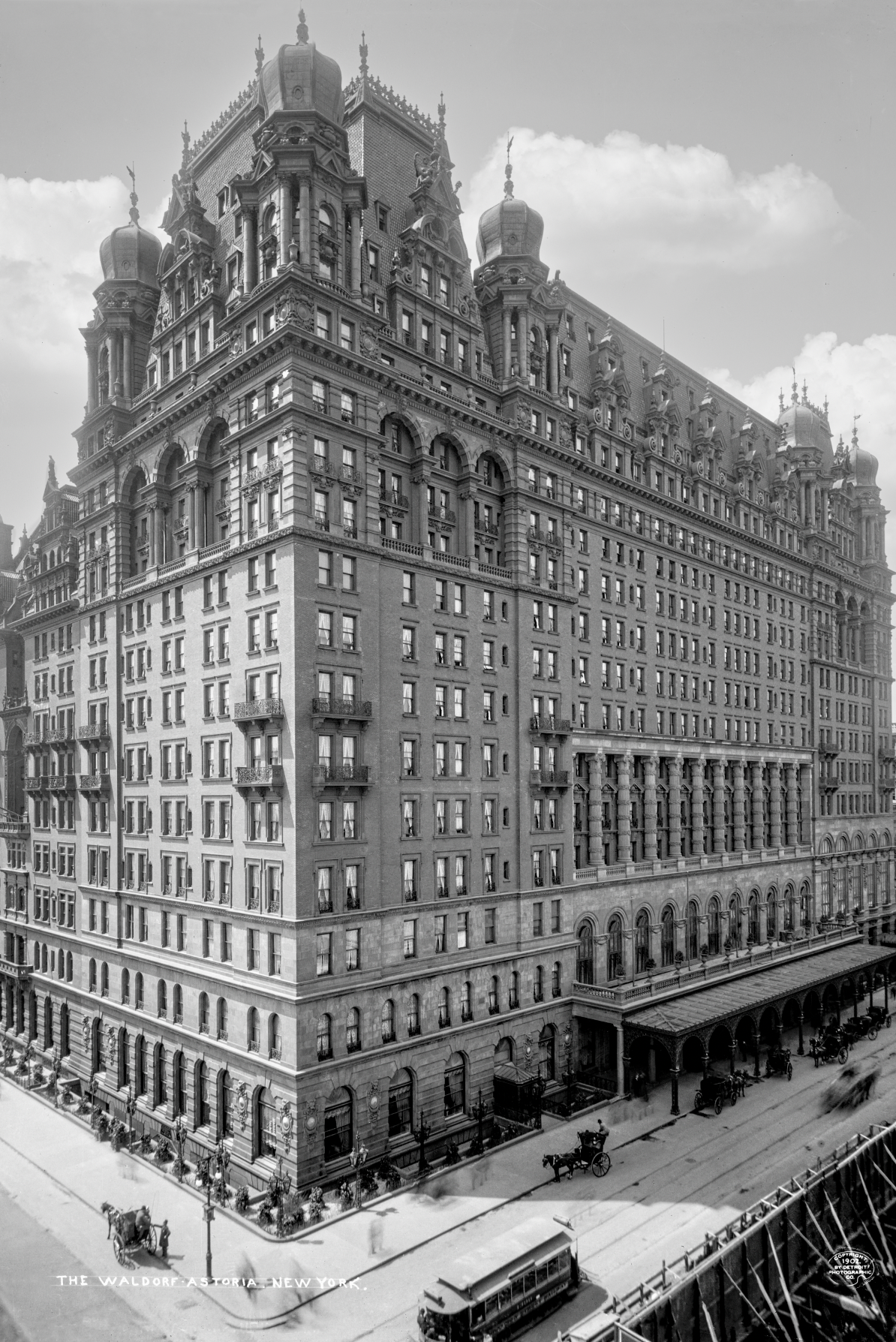

Six New York Landmarks That Changed the Manhattan Skyline
New York's skyline wasn't built overnight. Vintage photographs of Trinity Church, the Plaza, Waldorf-Astoria, Chrysler Building, Empire State Building and Rockefeller Center reveal how Manhattan grew from a city of church steeples and grand hotels into the skyscraper capital of the world.

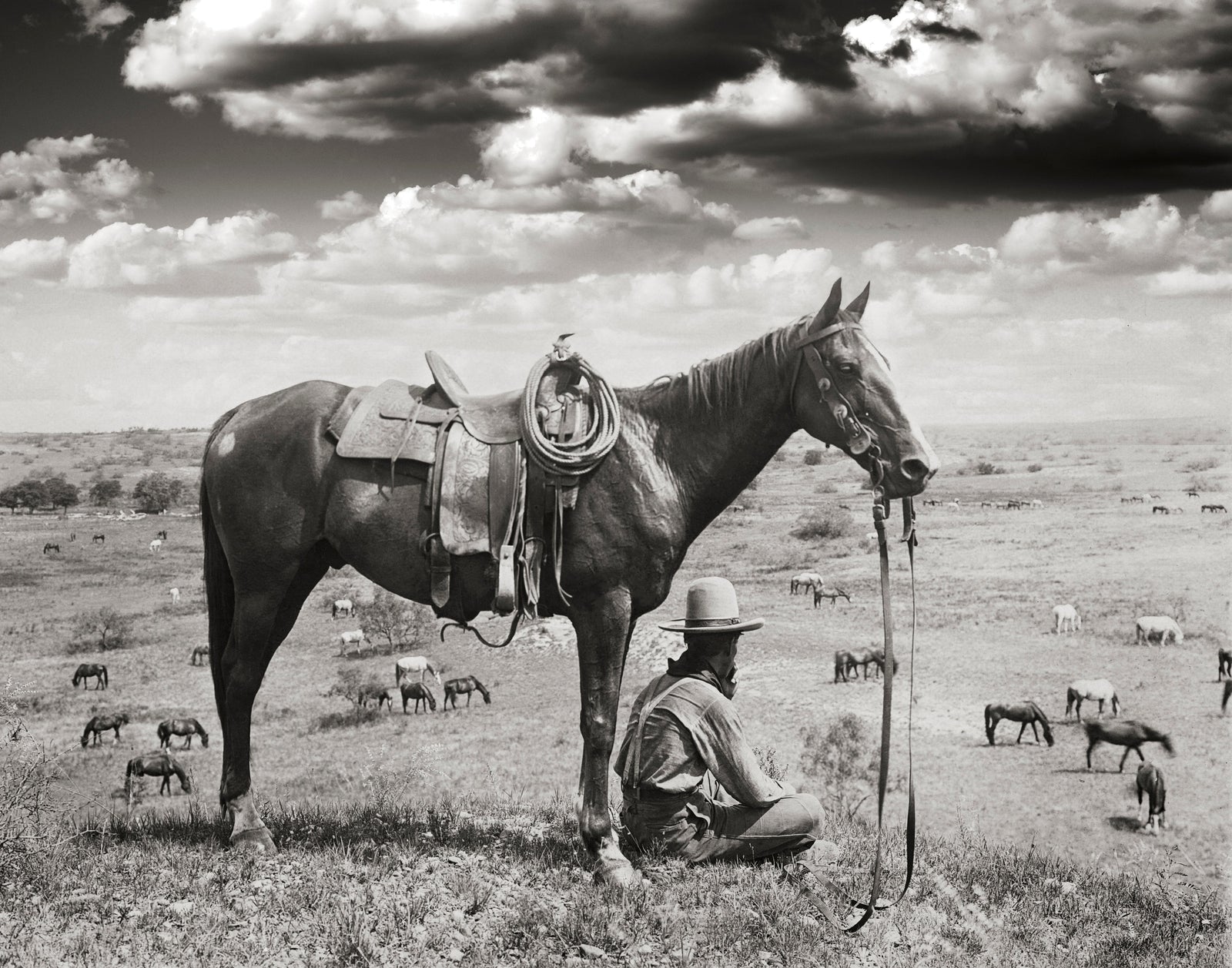

The Old West Never Really Ended
A cowboy on horseback overlooks the Dallas skyline in 1943—an image that seems to capture the Old West and modern America in a single frame. But the cowboy didn't disappear when the frontier closed. Discover how real working cowboys, rodeos, music and Hollywood carried the Old West into the 20th century.
Let customers speak for us
Gems
These short clips are gems. They are part of the history of music in America. Thank you for posting.
S. Kelley Chambers

Love the print and perfect decor for our n...
Love the print and perfect decor for our new apartment in Pittsburgh.
Chris P

5 stars review from Laura
5 stars review from Laura
Laura D

5 stars review from Geri
5 stars review from Geri
Geri L

5 stars review from Stephanie
5 stars review from Stephanie
Stephanie

5 stars review from Brookelynz
5 stars review from Brookelynz
Brookelynz
5 stars review from Deborah
5 stars review from Deborah
Deborah G

Spectacular!
Received as a gift and could not be happier with the quality of the print. Shipping container ensure this arrived in perfect condition.
John

5 stars review from Kayla
5 stars review from Kayla
Kayla G

5 stars review from Blondiee
5 stars review from Blondiee
Blondiee

5 stars review from April
5 stars review from April
April Y

5 stars review from Tracie
5 stars review from Tracie
Tracie C

Great quality and fast delivery!
Great quality and fast delivery!
Amanda C

5 stars review from Autumnrayne4
5 stars review from Autumnrayne4
Autumnrayne4

5 stars review from Traca
5 stars review from Traca
Traca B
