

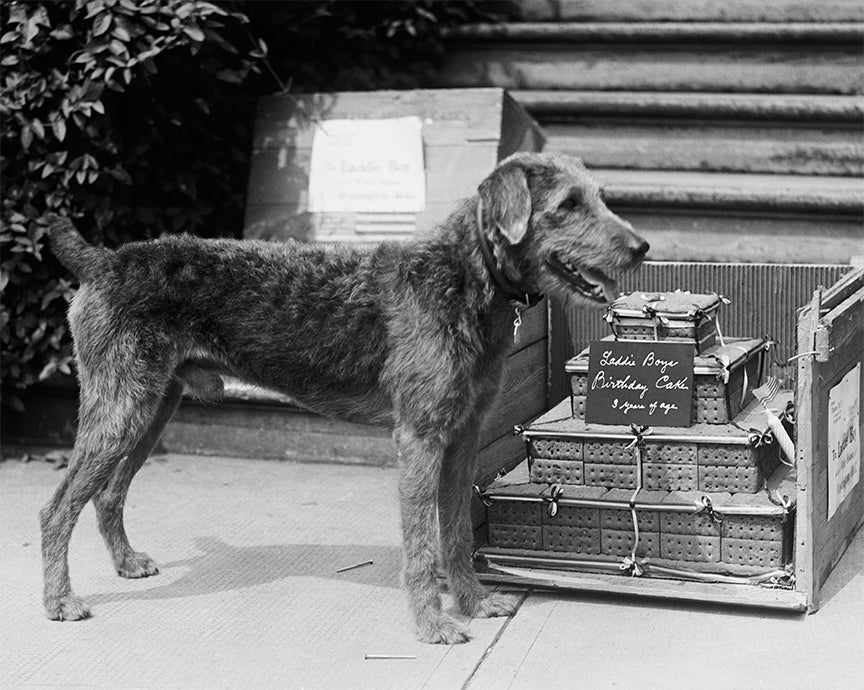

The First Celebrity White House Dog - Laddie Boy
Laddie Boy, President Harding's dog gets a doggie cake, 1921. Laddie Boy, an Airedale Terrier, graced the presence of U.S. President Warren G. Harding during his time in the White House. Laddie Boy was presented to President Harding by Charles Quetschke of Caswell Kennels, becoming an instant celebrity during the Harding administration.
This faithful companion proved his loyalty time and again. Whenever the president played golf and encountered a wayward shot, Laddie Boy dutifully retrieved the ball from the trees. In Cabinet meetings, he had his very own hand-carved chair to relax in. The White House even hosted birthday parties in his honor, inviting neighborhood dogs to join the festivities, complete with dog biscuit cake. The newspapers even published playful interviews with Laddie Boy, capturing the public's imagination.
As the first "First Dog" to receive regular coverage in the national press, Laddie Boy held a special place in the hearts of the American people. President Harding and First Lady Florence shared a deep love for animals, and Laddie Boy became a symbol for their advocacy of animal rights and welfare.
Legend has it that Laddie Boy sensed his master's impending passing. Prior to President Harding's death in August 1923, the dog reportedly howled incessantly for three days at the Palace Hotel in San Francisco. In tribute to President Harding, newsboys collected thousands of pennies, later transformed into a statue of Laddie Boy, commemorating the bond between the president and his loyal companion. Although the statue was presented to the Smithsonian Institution, it remained unfinished due to the untimely passing of Mrs. Harding.
See Laddie's photo here.
Following President Harding's death, Florence Harding entrusted Laddie Boy to Harry Barker, her favorite Secret Service agent, knowing her declining health would prevent her from caring for the dog properly. Laddie Boy found a loving home with the Barker family in Boston, where he lived a content and cherished life. His passing in 1929 garnered headlines across the country, marking the end of an era.
To honor Laddie Boy's memory, a bronze statue depicting him alongside President Harding stands in Rapid City, South Dakota, as part of the city's "City of Presidents" art installation. Unfortunately, in 2012, Laddie Boy's distinctive collar, crafted from Alaskan gold nuggets, was stolen from the Harding Home and Museum, leaving a void in the collection and a reminder of the dog's extraordinary history.
Leave a comment
Comments will be approved before showing up.
Also in Time Capsule





The Birth of a Floating Dream: Building the Titanic
In the years since its sinking, Titanic has become a symbol of both human achievement and human fallibility. Its construction remains a subject of fascination, not only for the scale of the project, but for what it reveals about the values and priorities of the time. The ship was built with extraordinary care and expertise, yet it was also shaped by assumptions that would ultimately prove flawed.
Let customers speak for us
Gems
These short clips are gems. They are part of the history of music in America. Thank you for posting.
S. Kelley Chambers

Love the print and perfect decor for our n...
Love the print and perfect decor for our new apartment in Pittsburgh.
Chris P

5 stars review from Laura
5 stars review from Laura
Laura D

5 stars review from Geri
5 stars review from Geri
Geri L

5 stars review from Stephanie
5 stars review from Stephanie
Stephanie

5 stars review from Brookelynz
5 stars review from Brookelynz
Brookelynz
5 stars review from Deborah
5 stars review from Deborah
Deborah G

Spectacular!
Received as a gift and could not be happier with the quality of the print. Shipping container ensure this arrived in perfect condition.
John

5 stars review from Kayla
5 stars review from Kayla
Kayla G

5 stars review from Blondiee
5 stars review from Blondiee
Blondiee

5 stars review from April
5 stars review from April
April Y

5 stars review from Tracie
5 stars review from Tracie
Tracie C

Great quality and fast delivery!
Great quality and fast delivery!
Amanda C

5 stars review from Autumnrayne4
5 stars review from Autumnrayne4
Autumnrayne4

5 stars review from Traca
5 stars review from Traca
Traca B
