

Henry Ford’s First Car
 Henry Ford's First Car,
Michael Burgan, History Author and playwright

At the Edison Illuminating Company, Henry Ford had flexible hours. He had time to visit local machine shops and learn more about making metal parts. And he had time to develop his new engine in a small workshop he built outside the Edison Company.
Fred Strauss was just one of the mechanics Ford recruited to help him build his first car. The two men got along well, and they often joked around. Ford made friends easily. Strauss said that “Henry had some kind of a ‘magnet.’ He could draw people to him.”
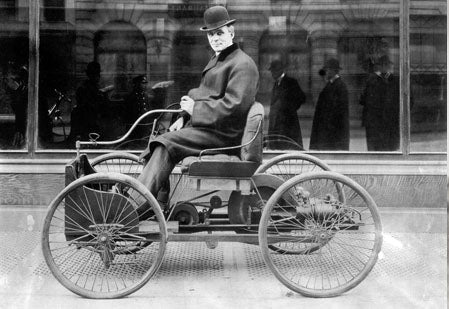
Finally, on June 4, 1896, Ford was ready to test his first vehicle. Ford called the vehicle a “buggy,” but his official name for it was the Quadricycle. It certainly didn’t look like a modern car. The driver sat on a short bench in the open cart and used a stick, instead of a wheel, to steer it. Its top speed was twenty miles per hour.
As he prepared for the car’s first run, Henry realized he had a problem. The vehicle was too wide to fit through the doors of his workshop! He had been working so hard to build his dream car, he never measured the front door! He took an ax and whacked at the bricks around the doorway to widen it. He then hopped in his “buggy” and headed down the streets of Detroit. The test ride was nearly perfect.
As he worked to develop his Quadricycle, Henry knew he was not alone. Inventors across America were racing to build automobiles. One had rumbled down the streets of Detroit just three months before. Like his car, that one also had a gas engine. But other early autos relied on steam engines or power from a battery.
Henry was convinced that his design was the best. The gas engine gave his car more power than an electric car, and it was lighter than steam cars. The Quadricycle was light and strong at the same time. Henry liked simple things that would work well and last a long time.
Shortly after his first drive in the Quadricycle, the Edison Illuminating Company took Henry to New York for a convention. In New York, Henry explained his gas engine to the founder of the company—the great inventor, Thomas Edison. He drew sketches to show how it worked. Edison’s advice to Henry was “Keep on with your engine. If you can get what you are after, I can see a great future.”
Those positive words thrilled Henry. Ford and Edison would eventually meet again and become close friends, sharing ideas and even vacationing together. Edison would praise Ford as a “natural mechanic” and a “natural businessman.” But in the summer of 1896, Henry still had a long way to go before people would compare him to Edison.
Michael Burgan studied history at the University of Connecticut before embarking on his career of writing about history, current events, geography, science, and more for children. He worked at Weekly Reader for six years before becoming a freelance author. He is a member of Biographers International Organization and edits its monthly newsletter, The Biographer's Craft. A produced playwright, he is also a member of the Dramatists Guild.
Leave a comment
Comments will be approved before showing up.
Also in Time Capsule




The Birth of a Floating Dream: Building the Titanic
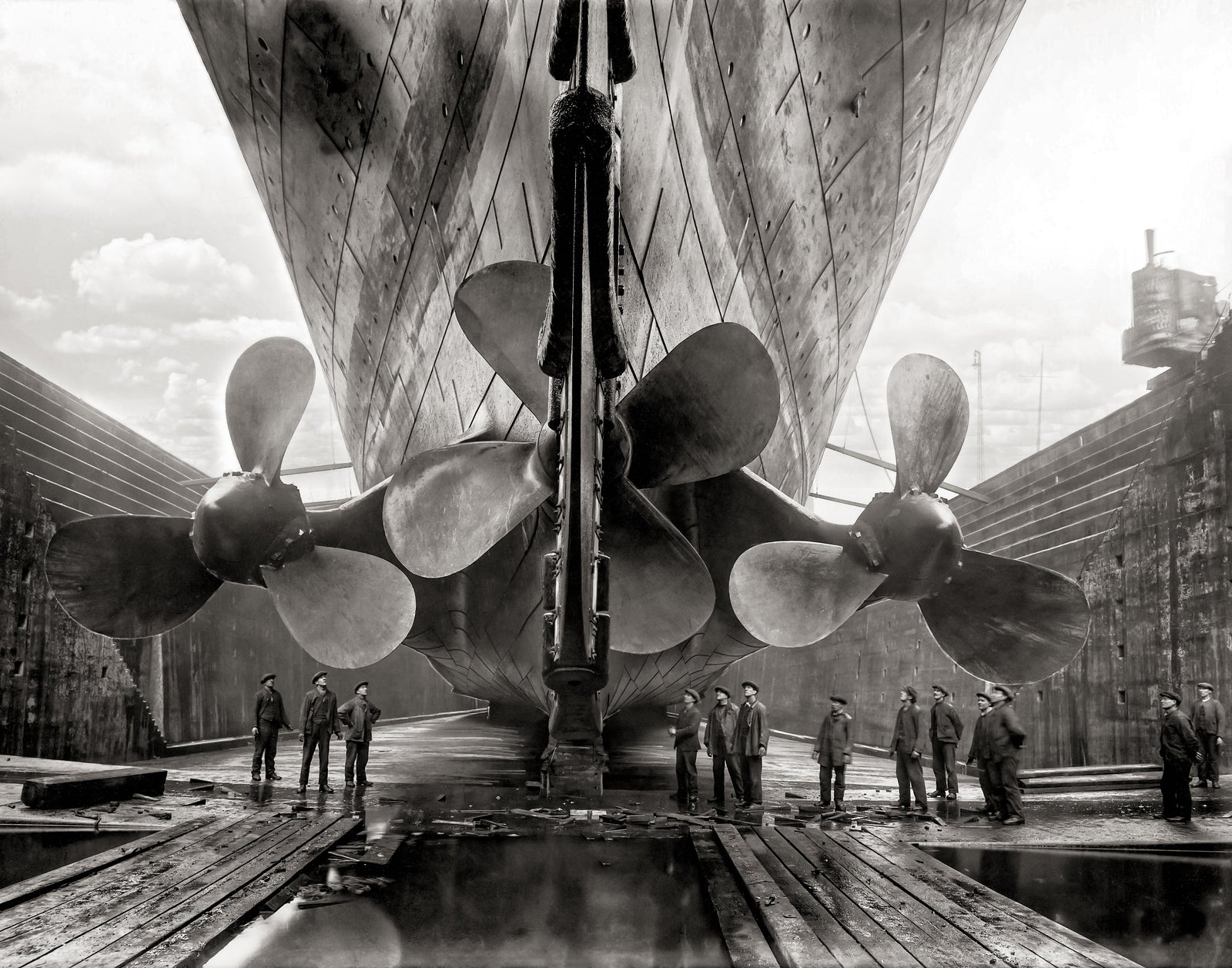
In the years since its sinking, Titanic has become a symbol of both human achievement and human fallibility. Its construction remains a subject of fascination, not only for the scale of the project, but for what it reveals about the values and priorities of the time. The ship was built with extraordinary care and expertise, yet it was also shaped by assumptions that would ultimately prove flawed.
Let customers speak for us
Love the print and perfect decor for our n...
Love the print and perfect decor for our new apartment in Pittsburgh.
Chris P

Pittsburgh, Pennsylvania, Mill District, Man Going To Work, 1940

5 stars review from Geri
5 stars review from Geri
Geri L

New England Fishing Schooner and Sailboat, 1907
5 stars review from Stephanie
5 stars review from Stephanie
Stephanie

Suffragettes Protesting, Women's March 1913 Program Cover
5 stars review from Deborah
5 stars review from Deborah
Deborah G

African American Girls Photo, St. Louis Missouri, 1940
Spectacular!
Received as a gift and could not be happier with the quality of the print. Shipping container ensure this arrived in perfect condition.
John

Pilgrim Monument, Provincetown, Barnstable County, MA, Summer, 1937
5 stars review from Kayla
5 stars review from Kayla
Kayla G

Four Messenger Girls, Western Union, Washington DC, 1925
5 stars review from Blondiee
5 stars review from Blondiee
Blondiee

Suffragettes On Their Way to Boston, Flanked by Men, Early 1900s
5 stars review from April
5 stars review from April
April Y

New York City, City Hall Subway Station, 1901
5 stars review from Tracie
5 stars review from Tracie
Tracie C

Las Vegas Motel Yucca and Little Chapel of the Flowers
Great quality and fast delivery!
Great quality and fast delivery!
Amanda C

Dallas Texas Skyline, Cowboy & Horse, Dallas Texas, 1943
5 stars review from Autumnrayne4
5 stars review from Autumnrayne4
Autumnrayne4

Painters on Brooklyn Bridge, Photo By Eugene de Salignac, NYC, 1914
5 stars review from Traca
5 stars review from Traca
Traca B

Shasta County, CA, "Eight Ball Pool Room," Photo, 1940s
I love it! It's beautiful! Thank you so mu...
I love it! It's beautiful! Thank you so much! Will definitely be ordering from this shop again!
Uuuhhhtash

Minneapolis Art, Foshay Tower Dedication, 1929