

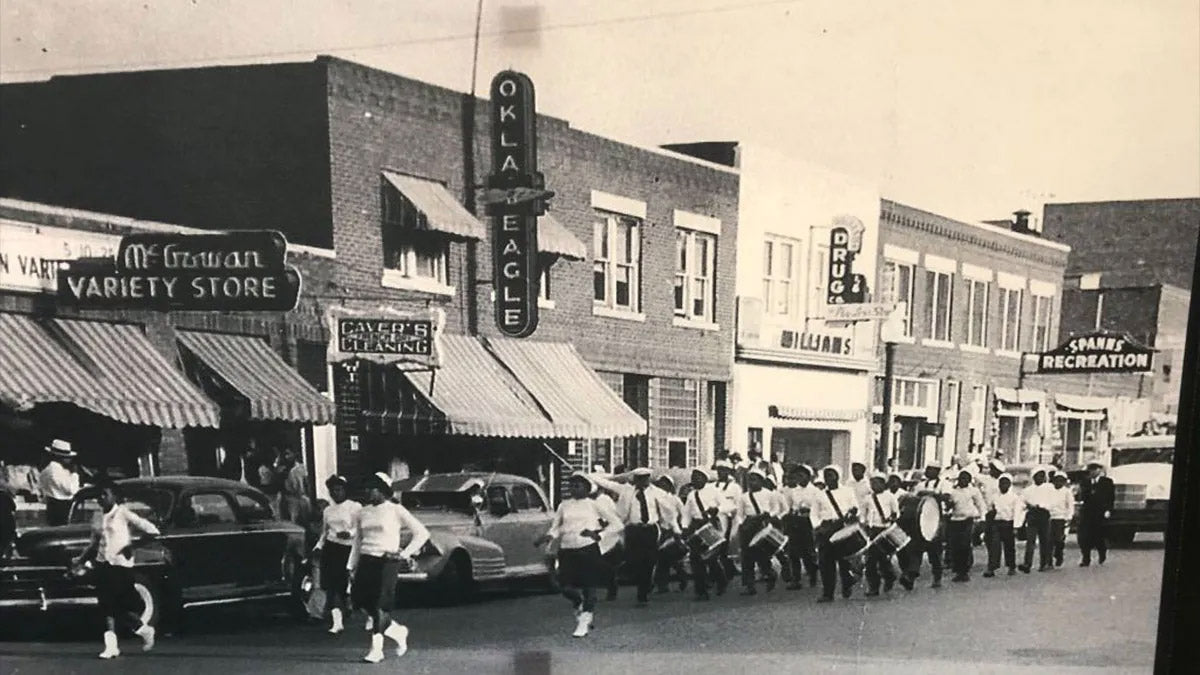

Black Wall Street: Prosperity, Destruction, and the Long Struggle for Justice
Greenwood Before the Flames (1906–1921)
In the early twentieth century, the Greenwood District of Tulsa, Oklahoma, became one of the most prosperous Black communities in the United States. Founded largely by Black families seeking opportunity and safety in the post–Reconstruction era, Greenwood thrived between roughly 1906 and 1921. Segregation laws forced Black residents to build their own institutions, but what emerged was not isolation—it was economic power.
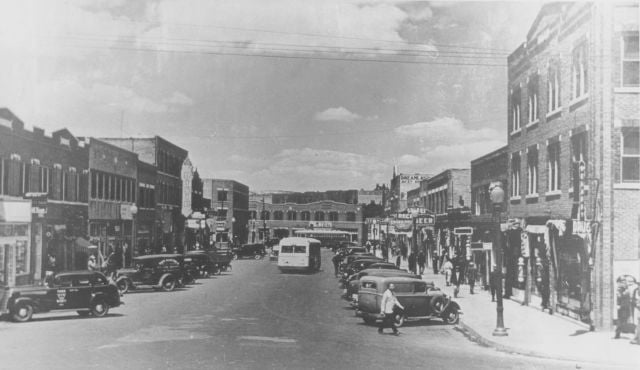
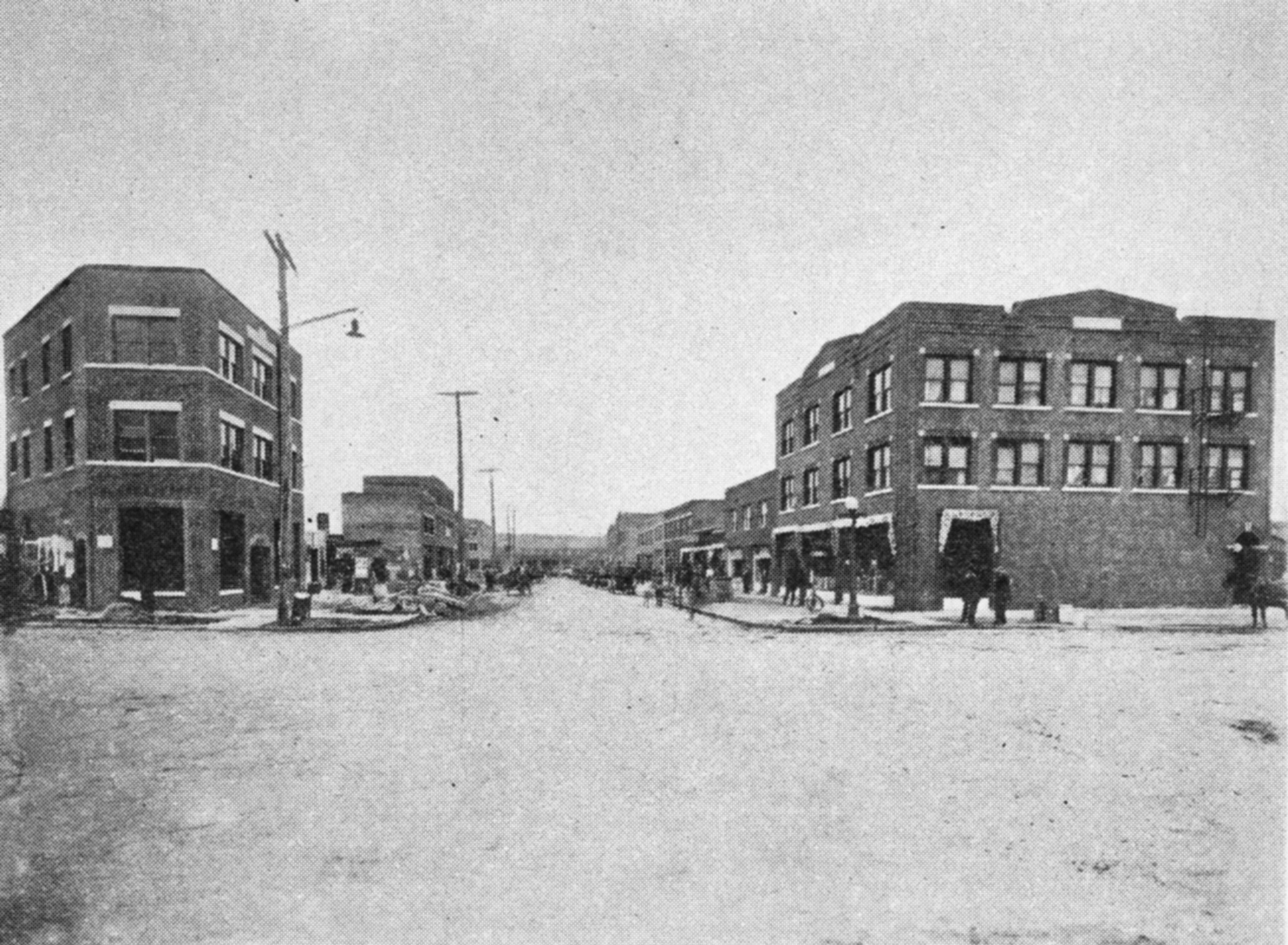
Greenwood’s success was shaped by figures such as O. W. Gurley, a landowner and entrepreneur who purchased forty acres in north Tulsa and sold parcels exclusively to Black residents. Gurley opened one of Greenwood’s first boarding houses and set the tone for a self-sustaining business district. Another key figure was J. B. Stradford, owner of the Stradford Hotel, one of the largest Black-owned hotels in the country, which catered to Black travelers barred from white accommodations.
By 1921, Greenwood contained more than 300 Black-owned businesses, including banks, grocery stores, newspapers, movie theaters, medical offices, and law practices. A. J. Smitherman, publisher of the Tulsa Star, used his paper to promote civic pride and economic independence. Doctors like A. C. Jackson, regarded as one of the finest surgeons in the nation at the time, practiced in Greenwood and symbolized its professional class. Money circulated within the community multiple times before leaving it, leading Booker T. Washington to reportedly refer to the district as “Negro Wall Street,” a nickname later shortened to Black Wall Street.
The Spark: May 30–31, 1921
The destruction of Black Wall Street began with a false accusation. On May 30, 1921, Dick Rowland, a 19-year-old Black shoeshiner, was accused of assaulting Sarah Page, a white elevator operator. The allegation was never substantiated, and Page later declined to press charges, but sensationalized newspaper coverage inflamed white Tulsa.
When rumors of a lynching spread, Black World War I veterans armed themselves and went to the courthouse to protect Rowland. Their presence was met with hostility. Late on May 31 and into June 1, white mobs—some deputized and armed by local authorities—invaded Greenwood.
The Tulsa Race Massacre (June 1, 1921)

 Over the course of approximately 18 hours, Greenwood was systematically destroyed. Homes and businesses were looted and burned. Eyewitness accounts and later investigations confirmed that private aircraft were used to drop incendiaries on Black-owned buildings—one of the first aerial bombings of a U.S. city.
An estimated 35 square blocks were reduced to ashes. Around 1,200 homes were destroyed. Contemporary death counts were deliberately minimized, but modern research estimates that as many as 300 Black residents were killed. Thousands were left homeless, many detained in internment-style holding areas while their neighborhood smoldered.
Local and state officials failed to protect Greenwood’s residents. Insurance companies later denied claims, citing riot clauses, ensuring that most victims received no compensation for their losses.
Immediate Aftermath and Resistance
Despite devastation, Greenwood residents did not disappear. Survivors rebuilt, often living in tents through the winter of 1921–1922. Leaders like Stradford, who was falsely accused of inciting violence, fled Tulsa to avoid prosecution, while others stayed and fought legal and political battles to reclaim land.
The city attempted to rezone Greenwood for industrial use, which would have permanently erased the community. Black Tulsans resisted through the courts and grassroots organizing, successfully blocking the rezoning and preserving the right to rebuild. By the late 1920s, Greenwood had regained a measure of economic vitality, though it never fully recovered its pre-1921 wealth.
Silence, Suppression, and Historical Erasure
For decades, the Tulsa Race Massacre was omitted from textbooks, newspapers, and public memory. Survivors were discouraged—or outright threatened—from speaking publicly. The silence itself became a second injustice, severing generational understanding of what had been lost and why.
This erasure delayed accountability. No one was ever criminally prosecuted for the massacre. Reparations were not paid. The economic gap created by the destruction of Greenwood compounded across generations, contributing to persistent racial wealth disparities.
Renewed Recognition and the Fight for Justice
In 1997, Oklahoma established a formal commission to investigate the massacre. The final report, released in 2001, confirmed mass killings, official complicity, and extensive property loss, and recommended reparations. While the report marked progress, its recommendations were largely ignored.
In the 21st century, survivors such as Viola Fletcher, Lessie Benningfield Randle, and Hughes Van Ellis became public voices for justice, testifying before Congress and filing lawsuits seeking accountability and restitution. Their advocacy reframed Black Wall Street not as a tragedy of the distant past, but as an unresolved civil rights issue.
Legacy and Meaning Today
Black Wall Street stands as both a testament to Black excellence and a warning about the fragility of progress in the face of racism and unchecked power. Greenwood’s rise proved that Black communities could generate immense wealth and cultural strength when given—even partially—the chance. Its destruction showed how quickly that success could be targeted and erased.
Today, remembrance efforts, memorials, and renewed scholarship have restored Greenwood to the national consciousness. Yet remembrance alone is not resolution. The story of Black Wall Street is not finished. It continues in courtrooms, classrooms, and public debates about reparations, historical truth, and what justice requires when prosperity is destroyed by violence and silence follows.
Black Wall Street was not simply burned. It was taken. And the reckoning for that loss is still unfolding.
Leave a comment
Comments will be approved before showing up.
Also in Time Capsule
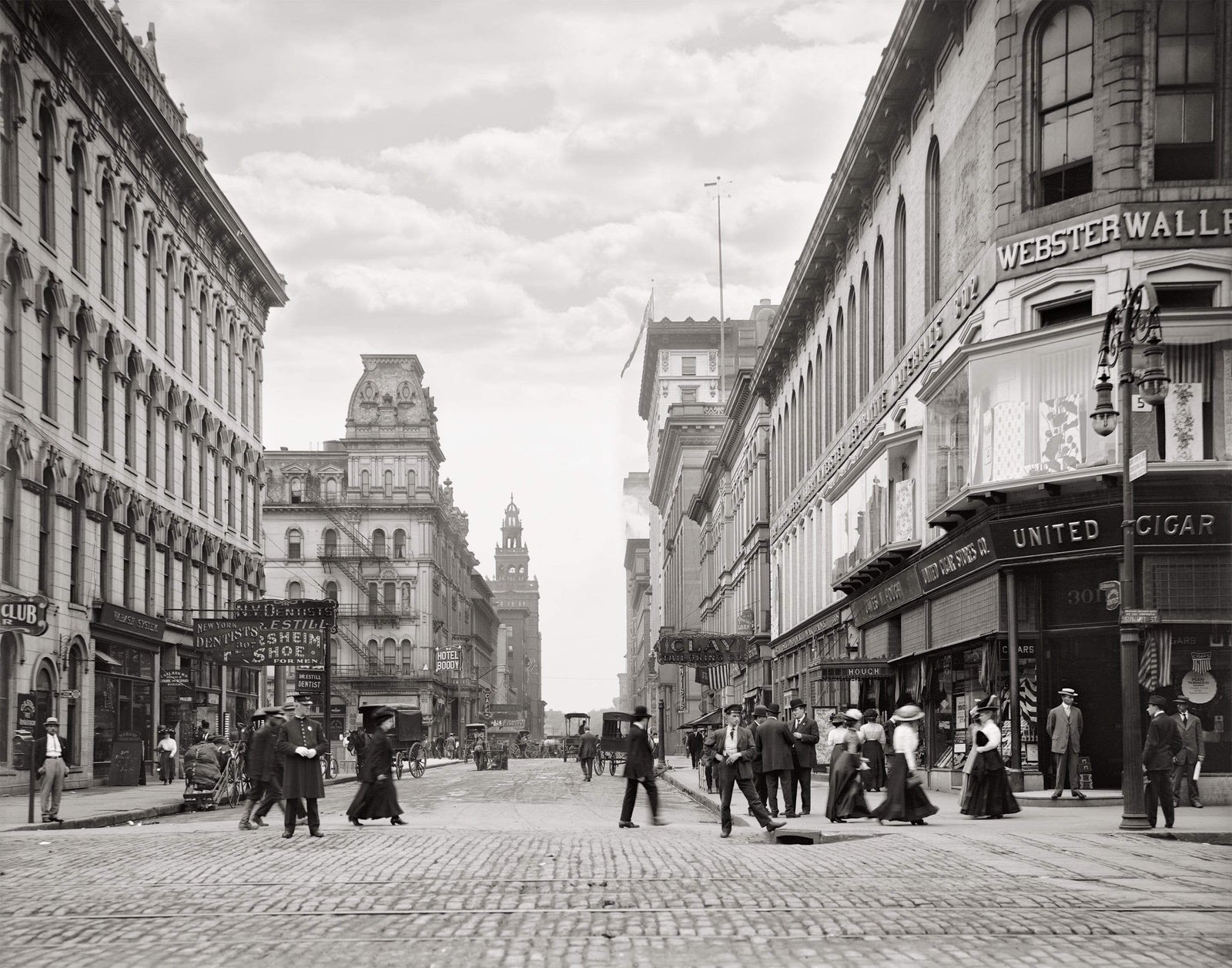

Toledo in 1900: Life on the Streets of the Glass City
Step onto the streets of Toledo, Ohio, around 1900, when horse-drawn carriages, bicycles, and electric streetcars shared a bustling downtown. Vintage photographs of Summit Street and Madison Avenue reveal the shops, hotels, businesses, and everyday life of the city as Toledo emerged as America’s Glass City.
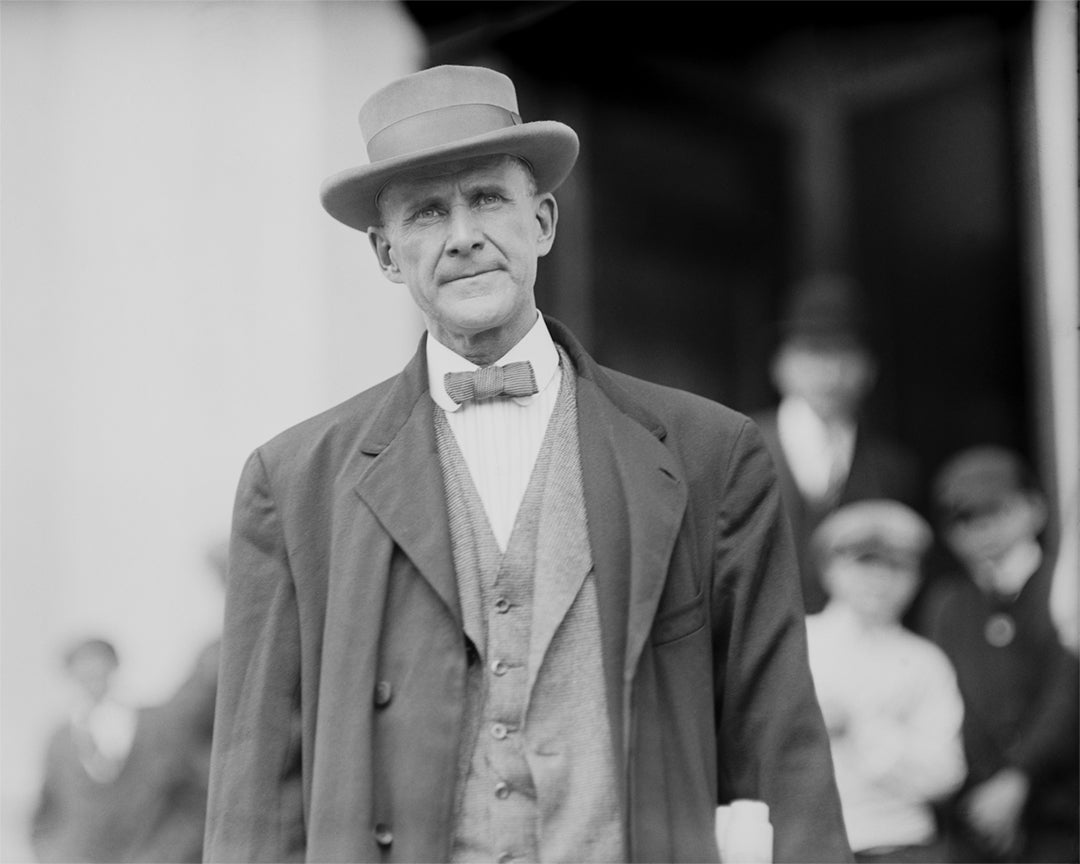

Eugene Debs and America’s Long Debate Over Socialism
More than a century before democratic socialism returned to American headlines, Eugene V. Debs was asking who should hold power in a democracy: workers, corporations or the government. Historical photographs reveal the world that made his five presidential campaigns possible.

Let customers speak for us
Gems
These short clips are gems. They are part of the history of music in America. Thank you for posting.
S. Kelley Chambers

Love the print and perfect decor for our n...
Love the print and perfect decor for our new apartment in Pittsburgh.
Chris P

5 stars review from Laura
5 stars review from Laura
Laura D

5 stars review from Geri
5 stars review from Geri
Geri L

5 stars review from Stephanie
5 stars review from Stephanie
Stephanie

5 stars review from Brookelynz
5 stars review from Brookelynz
Brookelynz
5 stars review from Deborah
5 stars review from Deborah
Deborah G

Spectacular!
Received as a gift and could not be happier with the quality of the print. Shipping container ensure this arrived in perfect condition.
John

5 stars review from Kayla
5 stars review from Kayla
Kayla G

5 stars review from Blondiee
5 stars review from Blondiee
Blondiee

5 stars review from April
5 stars review from April
April Y

5 stars review from Tracie
5 stars review from Tracie
Tracie C

Great quality and fast delivery!
Great quality and fast delivery!
Amanda C

5 stars review from Autumnrayne4
5 stars review from Autumnrayne4
Autumnrayne4

5 stars review from Traca
5 stars review from Traca
Traca B
