


From Southern Shores to New York Streets: The History of Italian Immigration to New York
Between the late 19th century and the early 20th century, millions of Italians left their homeland and crossed the Atlantic in search of opportunity. While Italians settled in cities across the United States, no place absorbed their presence more dramatically than New York City. By the early 1900s, New York had become the epicenter of Italian-American life—a gateway, a proving ground, and eventually, a cultural capital.
The story of Italian immigration to New York is not simply one of arrival. It is a story of poverty and resilience, prejudice and adaptation, labor and entrepreneurship. It is also a story of transformation—of how newcomers reshaped a city while being reshaped by it.
Why They Left Italy
Italian immigration came in waves, but the largest surge occurred between 1880 and 1924. During those decades, more than four million Italians emigrated to the United States.
The majority came from southern Italy and Sicily. The Italy they left was not the romanticized land of art and sunshine often imagined today. It was newly unified (in 1861), economically unstable, and deeply unequal. Southern regions suffered from extreme poverty, limited industrial development, high taxes, and scarce land ownership. Agricultural workers faced crop failures and exploitative systems of tenancy.
For many families, emigration was not a dream—it was a survival strategy.
America offered something Italy could not: wages. Even low-paying factory or construction jobs in New York promised income far beyond what rural laborers could earn at home.
Arrival at Ellis Island
Beginning in 1892, most Italian immigrants entered through Ellis Island.
The journey across the Atlantic often took weeks in crowded steerage compartments. Conditions were cramped and unsanitary. Upon arrival, immigrants underwent medical and legal inspections. Those deemed ill or unable to support themselves could be detained or deported.
For the vast majority, however, entry was granted.
They stepped into a city already dense with other immigrant groups—Irish, German, Jewish, and Eastern European communities had arrived earlier. Italians entered a competitive urban landscape where housing was tight and jobs were physically demanding.
Settlement in Little Italy
Most Italians initially settled in lower Manhattan, particularly around Mulberry Street. This neighborhood became known as Little Italy.

Photo Available: New York City, Mulberry Street, New York, early 1900s
Tenement housing defined daily life. Buildings were overcrowded, poorly ventilated, and often lacked indoor plumbing. Families sometimes shared single rooms. Disease spread easily.
Yet these neighborhoods also provided familiarity. Residents spoke regional dialects. Churches anchored community life. Mutual aid societies offered financial and social support. Italian-language newspapers circulated news from both America and the old country.
Italian immigrants often identified more with their specific village or region than with Italy as a unified nation. Calabrians, Neapolitans, Sicilians—each group carried distinct customs.
In New York, proximity blurred some of those differences over time.
Labor and Economic Survival
Work was physically demanding and often dangerous.
Italian men found employment in construction, street paving, railroad building, dock labor, and factory work. Many helped build the very infrastructure that made New York modern—bridges, tunnels, subways, and skyscrapers.
Women frequently worked in garment factories or took in piecework at home. Children contributed income as soon as they were able.
One common pattern was temporary migration. Many Italian men intended to earn money in America and return home. Some did. Others eventually brought families over and settled permanently.
Entrepreneurship also emerged early. Pushcart vendors sold fruit and vegetables. Grocery stores, bakeries, barber shops, and restaurants followed. These small businesses laid the foundation for upward mobility.

Photo Available: New York City Clam Truck, Street Food, Early 1900s:
Prejudice and Violence
Italian immigrants did not enter a welcoming society.
They were often portrayed in newspapers as uneducated, criminal, or politically radical. Stereotypes associated Italians with organized crime long before such networks became prominent.
Violence occurred. In 1891, 11 Italian immigrants were lynched in New Orleans after being accused of involvement in a police chief’s murder—a crime for which most had been acquitted. Though this happened outside New York, it reflected broader hostility.
In New York, Italians faced discrimination in employment and housing. Signs reading “No Italians” were not uncommon.
Despite this, communities persisted. Prejudice slowed assimilation but did not prevent it.
Religion and Identity
The Catholic Church played a central role in Italian-American life.
Many Italian immigrants were devout Catholics, but they often felt marginalized within Irish-dominated parishes. As a result, Italian national parishes formed, offering services in familiar dialects.
Religious festivals became public expressions of identity. The Feast of San Gennaro, first held in 1926 in Little Italy, brought music, processions, and food into the streets. These festivals asserted presence in a city that sometimes viewed Italians as outsiders.
Faith and tradition offered continuity during uncertain transitions.
Political Awakening and Organization
As Italian communities grew, political engagement increased.
Early generations were cautious, focused on economic stability. But over time, Italian-Americans entered municipal politics and labor unions.
Labor activism was significant. Italian workers participated in strikes and organizing efforts, particularly in construction and garment industries. Some were influenced by socialist or anarchist ideas, which fueled suspicion among authorities.
By the mid-20th century, Italian-Americans had established political influence in New York neighborhoods.
The Immigration Act of 1924
The era of mass Italian immigration ended abruptly with the Immigration Act of 1924. This federal law established national origin quotas severely limiting arrivals from southern and eastern Europe.
Italian immigration declined sharply. By then, however, millions had already settled in the United States, many in New York.
The community shifted from newcomer status to second-generation American identity.
World War II and Changing Perceptions
During World War II, Italy’s alliance with Nazi Germany complicated Italian-American identity. Some immigrants were classified as “enemy aliens,” and limited restrictions were imposed.
Yet thousands of Italian-Americans served in the U.S. military. Their participation reinforced loyalty and accelerated acceptance.
After the war, assimilation deepened. English replaced dialects in homes. Education levels rose. Suburban migration began. Little Italy’s population gradually declined as families moved to outer boroughs like Brooklyn, Queens, and the Bronx.
Cultural Contributions
Italian immigrants profoundly shaped New York’s cultural landscape. Cuisine is perhaps the most visible contribution. What Americans now think of as “Italian food”—pizza, pasta dishes, red sauce restaurants—evolved in New York. Foods once regional became national staples.

Photo Available: Italian Grocer, Little Italy, 1943
Music, film, literature, and fashion also reflect Italian-American influence. From opera houses to doo-wop street corners, cultural expression flourished.
In construction and architecture, Italian craftsmen left physical marks on buildings across the city.
Organized crime, often sensationalized, became part of public perception. While a minority engaged in criminal enterprises, media narratives sometimes overshadowed broader community achievements.
Decline of Old Little Italy
By the late 20th century, Manhattan’s Little Italy had shrunk significantly. Chinatown expanded. Rising real estate prices changed neighborhood demographics.
Yet traces remain—restaurants, festivals, storefronts.

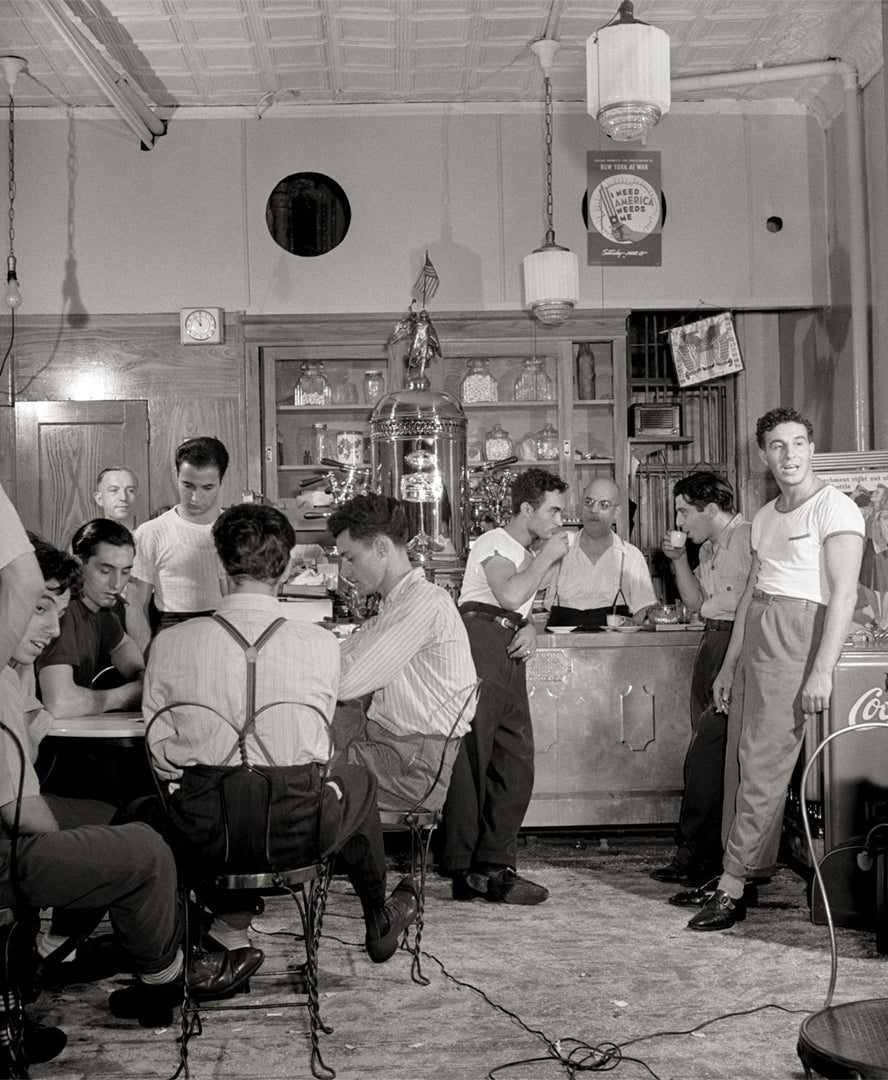
Photo Available: Italian-American, Coffee Shop, Little Italy, NYC
The symbolic importance of Little Italy persists even as residential patterns evolve.
Italian-American communities now thrive across the New York metropolitan area—in Staten Island, Bensonhurst, and beyond.
Contemporary Identity
Today, Italian-American identity in New York is layered. Fourth- and fifth-generation descendants often maintain cultural traditions—food, holidays, family networks—while fully integrated into broader American society.

Photo Available: NYC, Italian Restaurant, Man With Spaghetti, 1957
New immigration from Italy continues at a smaller scale, often involving professionals and students rather than laborers.
Legacy in the City’s Fabric
Italian immigrants helped build New York physically and culturally. They laid bricks, paved roads, excavated tunnels. They opened businesses that still anchor neighborhoods. They shaped the city’s soundscape and cuisine.
Their journey reflects a broader immigrant arc: departure under hardship, adaptation under pressure, eventual integration with distinct cultural retention.

Photo Available: Celebrating New Year's Eve with the DiCostanzos, 1942
From Ellis Island processing rooms to Mulberry Street storefronts, from tenement kitchens to suburban homes, the arc of Italian immigration traces the transformation of both a people and a city.
The legacy is visible every time someone slices into a New York pizza, attends the Feast of San Gennaro, or walks past the fading street signs of Little Italy.
The ships have long since docked. The dialects have softened. But the imprint remains—woven permanently into New York’s identity.
Leave a comment
Comments will be approved before showing up.
Also in Time Capsule
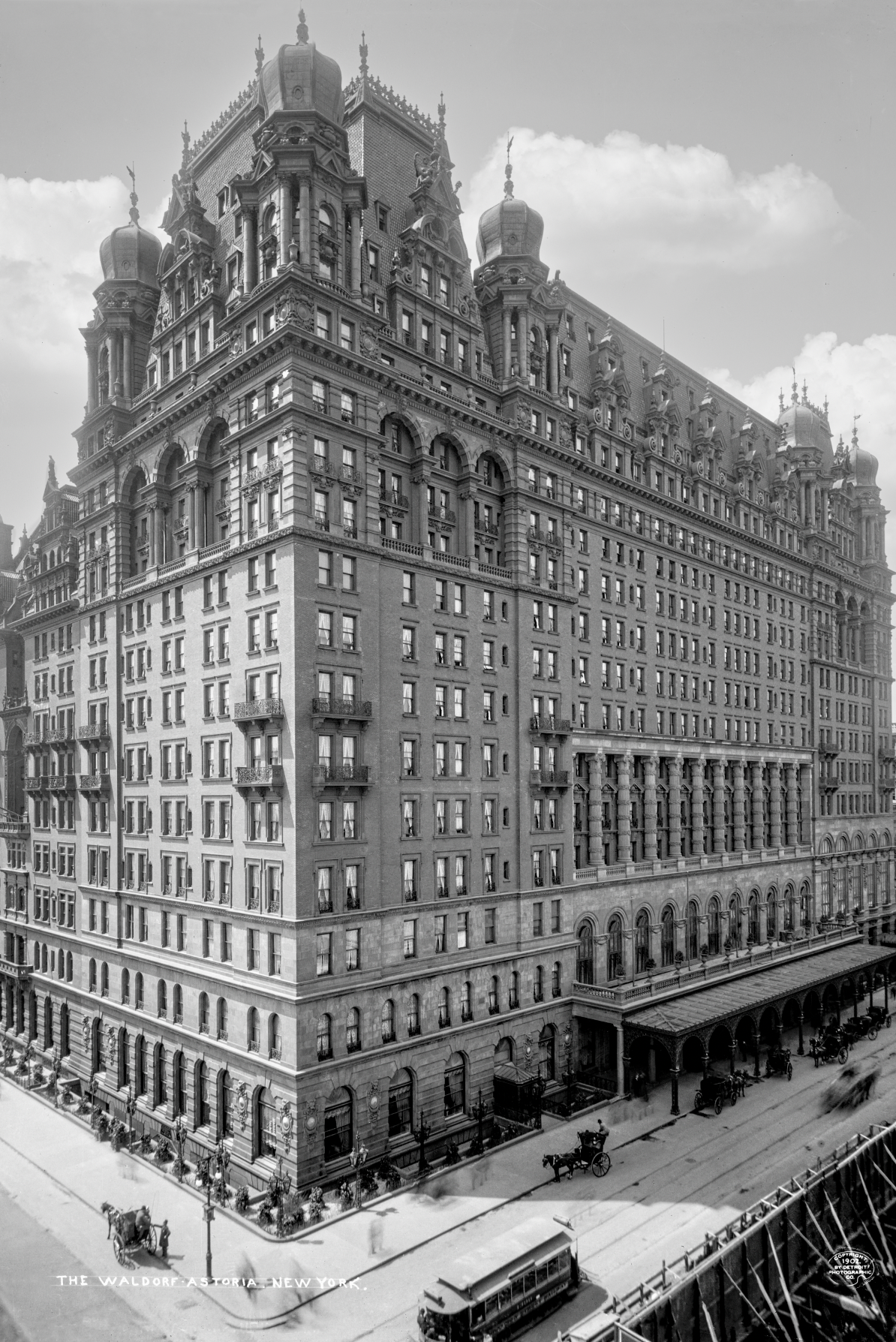

Six New York Landmarks That Changed the Manhattan Skyline
New York's skyline wasn't built overnight. Vintage photographs of Trinity Church, the Plaza, Waldorf-Astoria, Chrysler Building, Empire State Building and Rockefeller Center reveal how Manhattan grew from a city of church steeples and grand hotels into the skyscraper capital of the world.

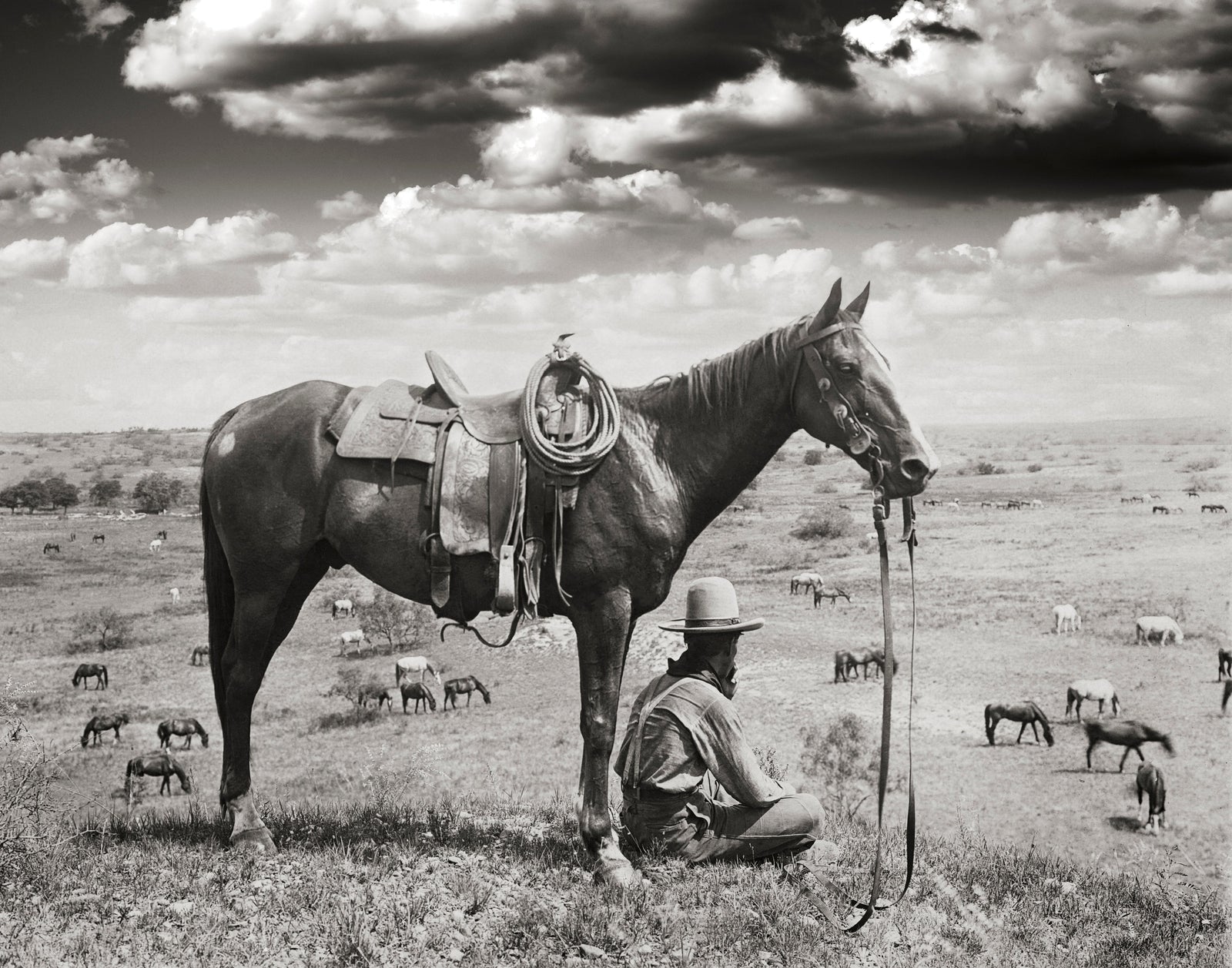

The Old West Never Really Ended
A cowboy on horseback overlooks the Dallas skyline in 1943—an image that seems to capture the Old West and modern America in a single frame. But the cowboy didn't disappear when the frontier closed. Discover how real working cowboys, rodeos, music and Hollywood carried the Old West into the 20th century.
Let customers speak for us
Gems
These short clips are gems. They are part of the history of music in America. Thank you for posting.
S. Kelley Chambers

Love the print and perfect decor for our n...
Love the print and perfect decor for our new apartment in Pittsburgh.
Chris P

5 stars review from Laura
5 stars review from Laura
Laura D

5 stars review from Geri
5 stars review from Geri
Geri L

5 stars review from Stephanie
5 stars review from Stephanie
Stephanie

5 stars review from Brookelynz
5 stars review from Brookelynz
Brookelynz
5 stars review from Deborah
5 stars review from Deborah
Deborah G

Spectacular!
Received as a gift and could not be happier with the quality of the print. Shipping container ensure this arrived in perfect condition.
John

5 stars review from Kayla
5 stars review from Kayla
Kayla G

5 stars review from Blondiee
5 stars review from Blondiee
Blondiee

5 stars review from April
5 stars review from April
April Y

5 stars review from Tracie
5 stars review from Tracie
Tracie C

Great quality and fast delivery!
Great quality and fast delivery!
Amanda C

5 stars review from Autumnrayne4
5 stars review from Autumnrayne4
Autumnrayne4

5 stars review from Traca
5 stars review from Traca
Traca B
