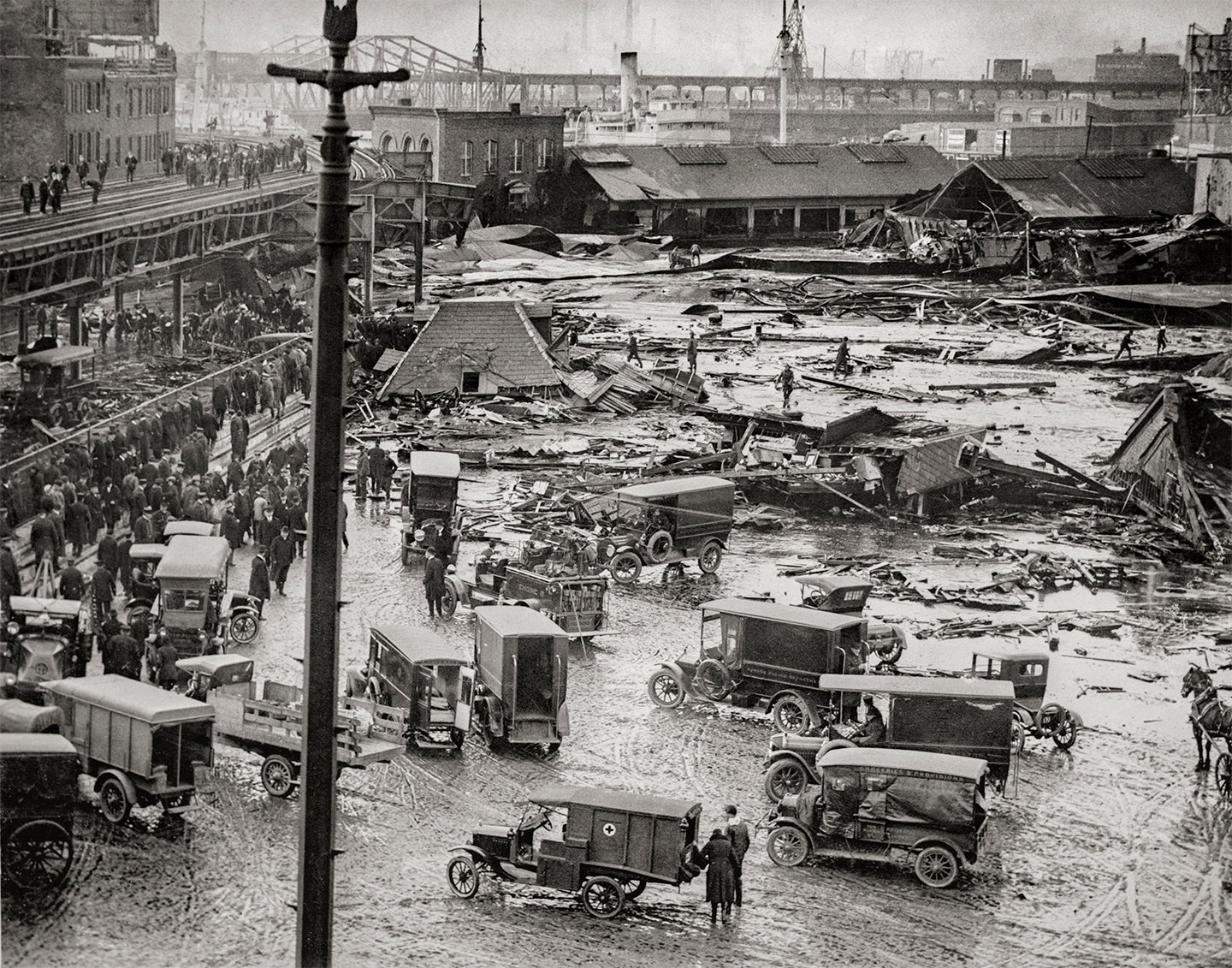

On January 15, 1919, the North End of Boston experienced one of the strangest and deadliest industrial disasters in American history. A massive storage tank filled with molasses suddenly ruptured, unleashing a wave of sticky, brown liquid that surged through the streets at an estimated 35 miles per hour. Buildings splintered, rail lines twisted, and people were swept away in a flood no one could have imagined possible.
It sounds almost absurd—until you understand the scale.

A Tank Built in Haste
The tank stood about 50 feet tall and 90 feet in diameter. It held roughly 2.3 million gallons of molasses. The structure was owned by the United States Industrial Alcohol Company, which used molasses to produce industrial alcohol—an ingredient in munitions and other products. The country had just emerged from World War I, and industrial production had been moving at full speed.
The tank had problems from the beginning. Residents reported that it leaked so badly children collected molasses in cups. Instead of fixing the underlying structural issues, the company reportedly painted the tank brown to hide the leaks.
On that cold January afternoon, temperatures rose suddenly after a period of freezing weather. The molasses inside the tank had recently been topped off with a fresh, warmer shipment. The pressure inside increased. Just after 12:30 p.m., the tank failed catastrophically.
A Wave Through the North End
The collapse created a wall of molasses reportedly 15 feet high. The force was powerful enough to knock buildings off foundations and send steel girders flying. The nearby elevated railway was damaged. Horses were trapped and suffocated. Rescue workers struggled to move through the thick liquid, which hardened as it cooled.
Twenty-one people were killed. About 150 were injured.
Emergency crews, police, and volunteers worked frantically, but the molasses made every effort slow and dangerous. Divers searching for victims had to feel their way through syrup so thick it restricted movement and breathing. The cleanup lasted weeks. Salt water from fire hoses was used to thin the molasses, which eventually washed into Boston Harbor.
For months afterward, locals claimed that on warm days, the faint smell of molasses lingered in the air.
Engineering Failure and Legal Consequences
What followed was one of the first major class-action lawsuits in Massachusetts history. Over 100 plaintiffs sued the company. The case dragged on for years, but in 1925, the court found the company liable. Investigators concluded the tank had been poorly designed and inadequately tested. Rivets were insufficient, steel was too thin, and basic engineering calculations had been neglected.
The company was ordered to pay damages—about $628,000 at the time, equivalent to millions today.
More importantly, the case helped establish stricter building codes and oversight for industrial construction. Before this disaster, corporate self-certification was common. Afterward, professional engineering standards became more rigorous and enforceable.
Why It Still Matters
The Great Molasses Flood is often remembered as a bizarre historical footnote. But strip away the novelty, and what remains is a serious lesson in negligence, industrial growth without oversight, and the human cost of cutting corners.
The disaster occurred during a period of rapid expansion—factories, storage facilities, and infrastructure were being built quickly to meet wartime demand. Safety lagged behind ambition. The tank in Boston became a symbol of that imbalance.
Today, the site is marked by a small plaque in the North End. Tourists sometimes smile at the strange story. But for the families who lost loved ones, it was no curiosity. It was a preventable tragedy.
History has a way of sounding strange from a distance. Up close, it’s usually about ordinary decisions—rushed timelines, ignored warnings, unchecked assumptions—that compound until something breaks.
On that January day in 1919, what broke was a steel tank. What followed reshaped engineering accountability in the United States.
Find the photo here.