

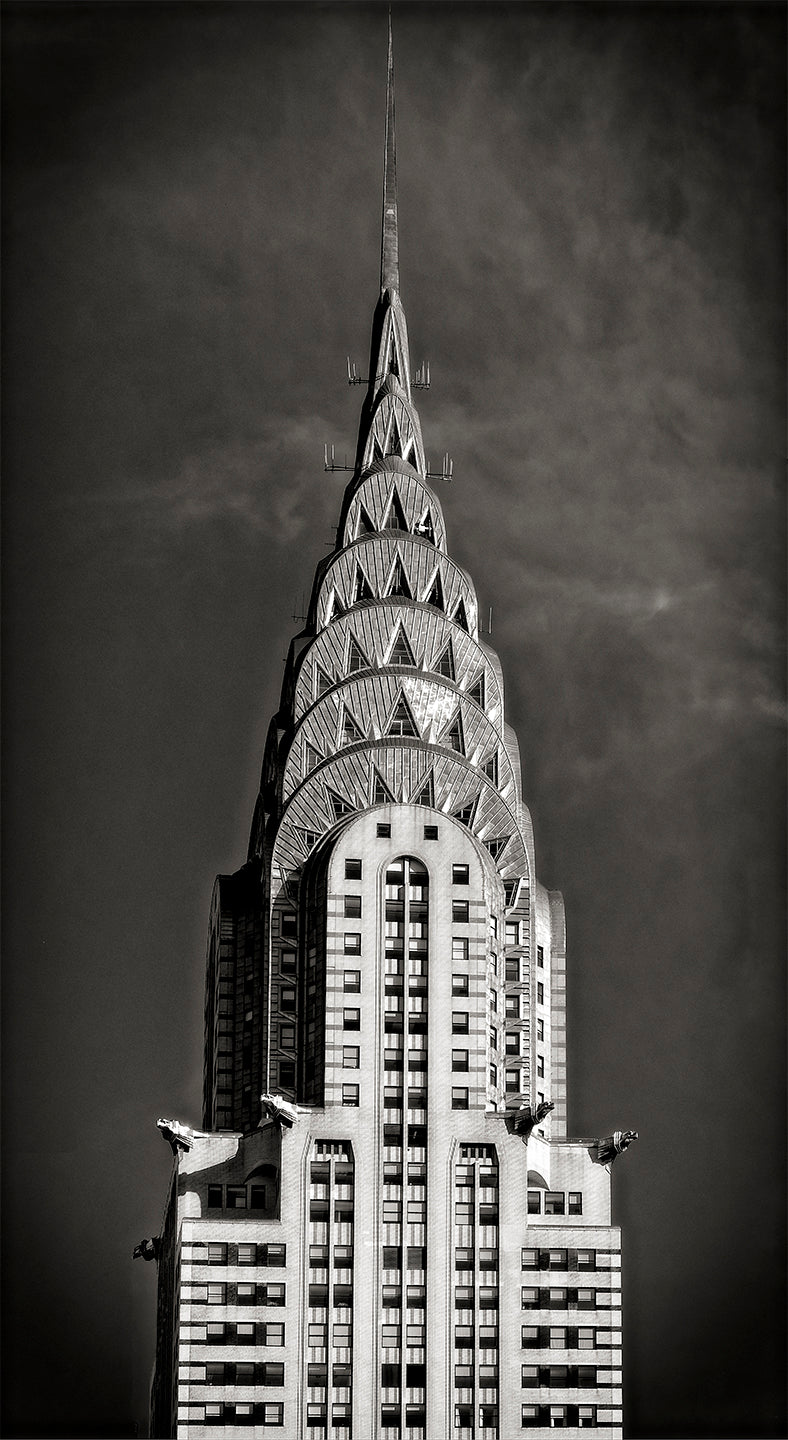

The History of the Chrysler Building
A Race to the Sky
In the late 1920s, New York was not simply building upward. It was competing with itself. Banks, automobile magnates, and developers were locked in a symbolic arms race to claim the tallest structure in the world. Height was prestige. Height was dominance. Height was modernity made visible.
Into that contest stepped Walter P. Chrysler, founder of the Chrysler Corporation. Unlike many developers of the era, Chrysler did not want a speculative office tower. He wanted a monument—something that would represent American industry and, more specifically, the machine age that had made him wealthy.
The site chosen was 405 Lexington Avenue, at 42nd Street, on land previously occupied by the old Grand Central Palace. The original developer, William H. Reynolds, had planned a conventional tall office building. But Reynolds lacked the capital to compete at the highest level. In 1928, Walter Chrysler stepped in, took control of the project, and fundamentally changed its ambition.
He did something unusual: he financed the building personally and retained ownership. This was not a corporate headquarters in the traditional sense. It was a statement piece.
William Van Alen and Art Deco Ascendant
Chrysler hired architect William Van Alen, a designer known for bold forms and European modern influences. Van Alen had studied at the École des Beaux-Arts in Paris, but he was not bound to classical restraint. He was drawn to modern materials and sculptural drama.
The late 1920s were the height of Art Deco—an aesthetic celebrating speed, geometry, ornament, and technological optimism. Unlike the Gothic verticality of the Woolworth Building, Art Deco embraced streamlined forms and machine-inspired details.
Van Alen seized the opportunity.
The building’s design featured a stepped crown, triangular windows, and stainless-steel cladding—materials rarely used at such scale. The setbacks were not merely decorative; they were required by New York’s 1916 Zoning Resolution, which mandated tiered forms to allow sunlight to reach the streets below. Van Alen turned regulation into art.
The most striking element would become the crown: a gleaming, layered spire constructed of Nirosta stainless steel. At a time when stone and brick dominated skyscrapers, this shimmering metal was radical.
The Secret Spire and the Height War
The Chrysler Building’s most dramatic chapter involves its rivalry with 40 Wall Street, then under construction by the Bank of Manhattan Company. Both projects sought the title of “world’s tallest building.”
Height claims in 1929 were fluid. Developers adjusted designs mid-construction, adding floors or ornamental tops to gain inches over competitors. The Bank of Manhattan believed it had secured victory at 927 feet.
Van Alen had a surprise. Without public announcement, he assembled a 185-foot stainless steel spire inside the building’s crown. In October 1929, workers hoisted it into place in sections, completing the maneuver in less than two hours. When installed, the Chrysler Building reached 1,046 feet—instantly surpassing its rival.
It held the title of tallest building in the world for less than a year, until the Empire State Building surpassed it in 1931. But the theatrical nature of the spire installation cemented the Chrysler’s legend.
It was not just tall. It was clever.
Construction in a Precarious Moment
Construction began in 1928 and proceeded at remarkable speed. At its peak, the building rose four floors per week. Approximately 3,000 workers were employed during its construction, and despite the era’s dangerous working conditions, there were no officially recorded fatalities—a rare statistic for skyscraper projects of the time. The building officially opened in May 1930.
Yet its completion coincided with catastrophe. The stock market crashed in October 1929. By the time the Chrysler Building opened, the United States was sliding into the Great Depression. Office space demand plummeted. Like many skyscrapers of the era, it initially struggled to fill tenants.
But its symbolic power endured. Even in economic collapse, it stood as an emblem of ambition.
Ornament of the Machine Age
What distinguishes the Chrysler Building from other skyscrapers is not its height, but its detail.
The gargoyles projecting from the 61st floor resemble Chrysler automobile hood ornaments—stylized eagles modeled after the 1929 Chrysler radiator caps. On lower setbacks, chrome hubcap motifs reference automotive wheel designs.
These were not subtle gestures. They were deliberate integrations of industrial branding into architecture.
The crown itself, composed of seven radiating arches clad in stainless steel, reflects sunlight differently at every hour. Its triangular windows create a sunburst pattern, reinforcing Art Deco’s fascination with geometry and motion.
Inside, the lobby is equally theatrical. It features marble walls, red Moroccan marble floors, and a ceiling mural titled “Transport and Human Endeavor,” painted by Edward Trumbull. The mural celebrates aviation, construction, and mechanized progress—an ode to speed and industry.
Unlike later minimalist corporate towers, the Chrysler Building embraced ornament unapologetically.
Ownership and Financial Strains
Walter Chrysler reportedly refused to pay Van Alen his full architectural fee, citing contractual disputes. Their relationship deteriorated, and Van Alen’s career never fully recovered. The building that defined him also marked his professional decline.
Chrysler retained ownership until his death in 1940. In 1953, the building was sold to William Zeckendorf for $18 million. Over the decades, ownership changed hands multiple times, reflecting New York’s evolving real estate economy.
The building’s land was eventually owned by Cooper Union, adding complexity to its financial structure. Lease agreements and maintenance costs would later influence its valuation dramatically.
Mid-Century Shifts
By the 1950s and 1960s, architectural taste shifted toward the International Style—glass curtain walls, minimalist lines, corporate restraint. Buildings like the Seagram Building redefined Park Avenue and Midtown.
The Chrysler Building, with its ornament and metallic flourish, seemed almost theatrical by comparison. Yet it avoided demolition, in part because it remained structurally sound and symbolically important.
In 1976, it was designated a National Historic Landmark. Landmark status protected it from radical alteration, ensuring its crown and facade would remain intact.
Decline and Revival
The late twentieth century brought financial and maintenance challenges. Stainless steel required upkeep. Mechanical systems aged. The building no longer represented cutting-edge office space compared to newer towers.
In 2008, the Abu Dhabi Investment Council acquired a majority stake. A decade later, in 2019, the building was sold at a dramatically reduced price to RFR Holding LLC and Signa Holding for $151 million—a fraction of its earlier valuations.
The price reflected lease complications and extensive renovation needs. For a time, observers speculated about its future viability as an office building.
Yet the structure itself remained intact, its crown still luminous over Midtown.
Cultural Symbolism
Few buildings have appeared as frequently in film and photography as the Chrysler Building. It has served as backdrop in science fiction, noir, romantic comedies, and disaster films.
Its silhouette is instantly recognizable—more so, arguably, than the Empire State Building’s rectangular mass. Photographers favor its crown at dusk, when the stainless steel captures fading light.
Unlike many skyscrapers defined by corporate tenants, the Chrysler Building became an aesthetic object independent of its function. It is architectural jewelry in a skyline of glass.
Art Deco in Context
The Chrysler Building stands as the definitive expression of Art Deco skyscraper design. While other buildings of the era adopted Deco elements, few integrated form and ornament so completely.
Art Deco itself emerged from the 1925 Exposition Internationale des Arts Décoratifs et Industriels Modernes in Paris. It celebrated craftsmanship, modern materials, and stylized geometry.
In New York, Art Deco became vertical. Setbacks, spires, and metalwork translated European decorative language into American scale.
The Chrysler Building is not merely an example of Art Deco. It is its high-water mark.
Engineering Achievement
The building’s steel skeleton weighs approximately 20,000 tons. Its foundation extends deep into Manhattan bedrock. The use of stainless steel cladding was pioneering; Nirosta alloy resisted corrosion and retained luster.
Elevator systems were advanced for their time, allowing efficient movement within a structure exceeding 1,000 feet.
The spire, constructed in segments, demonstrated precision prefabrication decades before modular construction became standard.
The building represented the intersection of architecture and engineering at a moment when both were accelerating.
The Observation Deck and Public Access
Originally, the Chrysler Building featured a public observation deck. Visitors could ascend to view Manhattan from one of the highest vantage points in the world.
However, competition from the Empire State Building’s larger and more profitable observation deck led to its closure in the 1940s. Today, the Chrysler Building does not offer public access to its upper floors, adding to its mystique.
The lobby remains open to visitors during business hours, preserving at least a glimpse of its interior grandeur.
Relationship to Midtown
The Chrysler Building’s location near Grand Central Terminal positioned it strategically within Midtown’s growth. As Midtown surpassed Lower Manhattan as the city’s commercial center, the building stood at the forefront of that shift.
Its presence helped define the east side of Manhattan’s skyline. When viewed from Queens or the East River, its crown acts as a focal point.
The building participates in skyline composition rather than dominating through bulk.
Restoration Efforts
Recent decades have included facade cleaning, mechanical upgrades, and interior restoration. Maintaining stainless steel at height is complex and expensive. Weather exposure, pollution, and wind erosion require ongoing care.
Preservationists emphasize that the building’s significance lies not only in height, but in material integrity. Altering its crown would fundamentally change its identity.
For now, the building remains largely intact—a rare survival in a city known for demolition cycles.
Why It Endures
The Chrysler Building held the title of world’s tallest building for only eleven months. Yet it endures more vividly in public imagination than many structures that surpassed it.
Why? Because it combines engineering ambition with aesthetic daring. It does not merely rise; it culminates. The crown resolves the vertical thrust with ornament rather than flattening into a box.
In an era increasingly dominated by glass curtain walls and supertall minimalism, the Chrysler Building represents a moment when architecture celebrated detail without apology.
It is both machine-age monument and handcrafted object.
The View from History
Looking back, the Chrysler Building reflects the contradictions of its era. It was built in prosperity and opened in collapse. It celebrated industry at the onset of economic depression. It embodied speed just as America slowed.
Yet it survived.
Today, it stands not as the tallest, not as the most technologically advanced, but as one of the most beloved structures in New York. Architects continue to cite it as a benchmark for integrating ornament with structure.
For historians, it represents the final, exuberant surge before modernism’s austerity took hold.
For photographers and artists, it is pure silhouette—recognizable from a fragment of crown or a glimpse of eagle.
For New York itself, it is proof that architecture can be theatrical without being frivolous.
The Chrysler Building is not simply a skyscraper. It is a statement about ambition, competition, material innovation, and the desire to leave a mark on the sky.
And nearly a century after its completion, it still does. See the photo here.
Leave a comment
Comments will be approved before showing up.
Also in Time Capsule
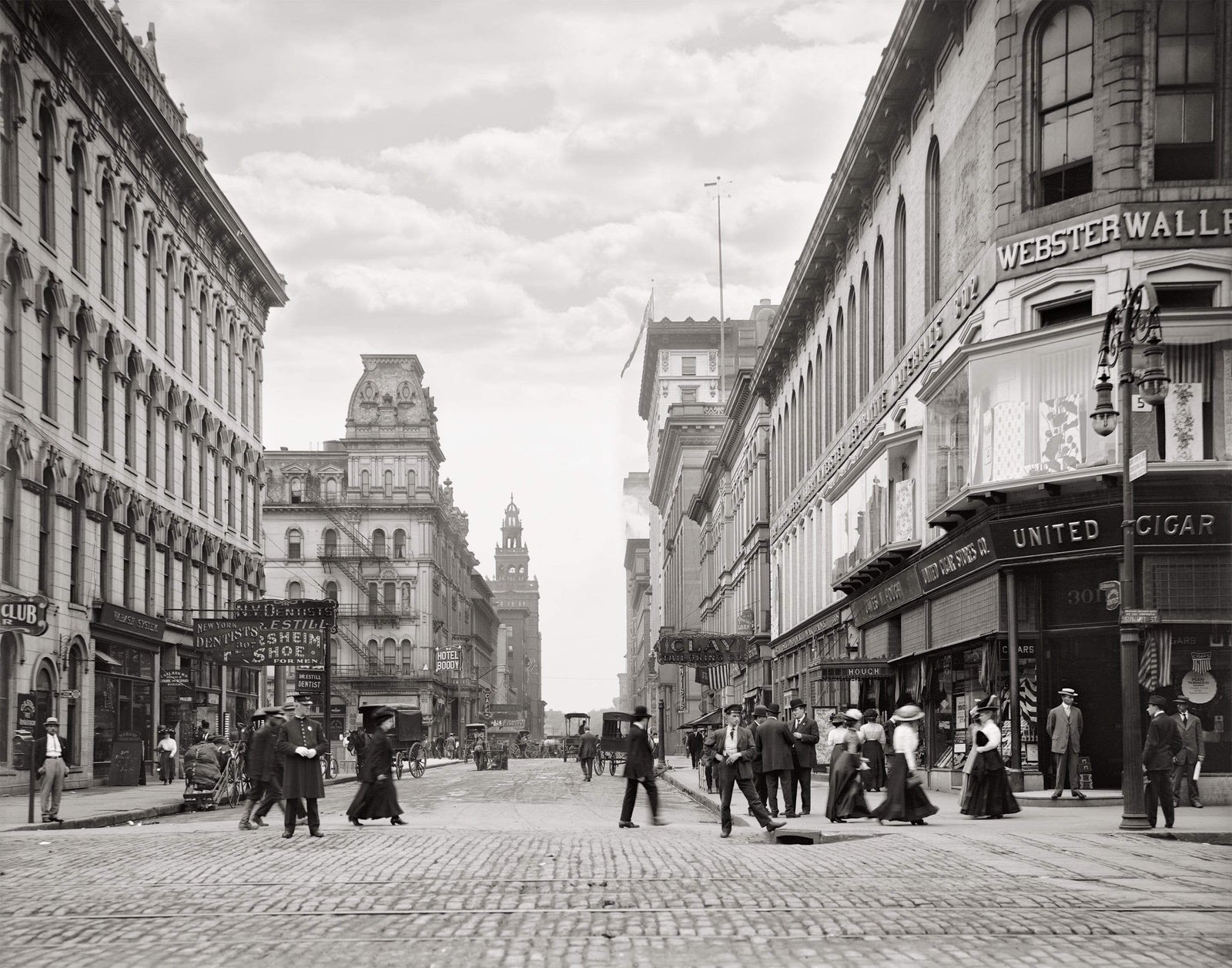

Toledo in 1900: Life on the Streets of the Glass City
Step onto the streets of Toledo, Ohio, around 1900, when horse-drawn carriages, bicycles, and electric streetcars shared a bustling downtown. Vintage photographs of Summit Street and Madison Avenue reveal the shops, hotels, businesses, and everyday life of the city as Toledo emerged as America’s Glass City.
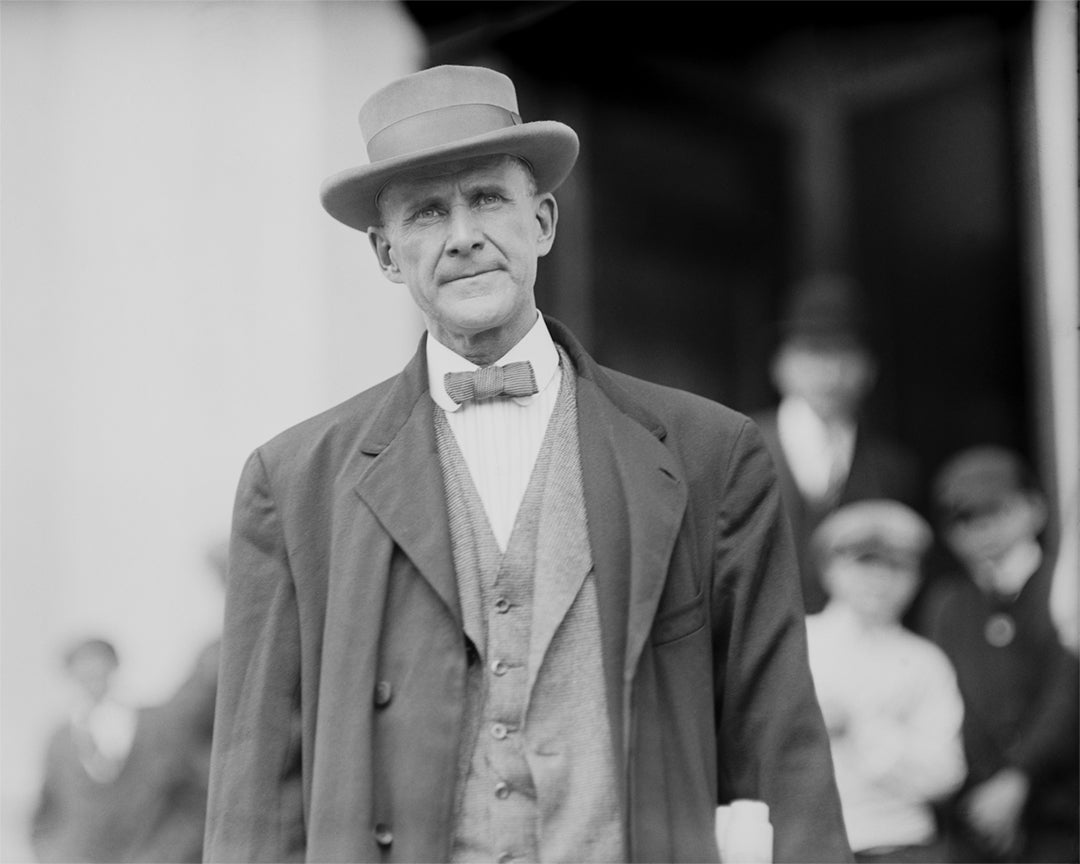

Eugene Debs and America’s Long Debate Over Socialism
More than a century before democratic socialism returned to American headlines, Eugene V. Debs was asking who should hold power in a democracy: workers, corporations or the government. Historical photographs reveal the world that made his five presidential campaigns possible.

Let customers speak for us
Gems
These short clips are gems. They are part of the history of music in America. Thank you for posting.
S. Kelley Chambers

Love the print and perfect decor for our n...
Love the print and perfect decor for our new apartment in Pittsburgh.
Chris P

5 stars review from Laura
5 stars review from Laura
Laura D

5 stars review from Geri
5 stars review from Geri
Geri L

5 stars review from Stephanie
5 stars review from Stephanie
Stephanie

5 stars review from Brookelynz
5 stars review from Brookelynz
Brookelynz
5 stars review from Deborah
5 stars review from Deborah
Deborah G

Spectacular!
Received as a gift and could not be happier with the quality of the print. Shipping container ensure this arrived in perfect condition.
John

5 stars review from Kayla
5 stars review from Kayla
Kayla G

5 stars review from Blondiee
5 stars review from Blondiee
Blondiee

5 stars review from April
5 stars review from April
April Y

5 stars review from Tracie
5 stars review from Tracie
Tracie C

Great quality and fast delivery!
Great quality and fast delivery!
Amanda C

5 stars review from Autumnrayne4
5 stars review from Autumnrayne4
Autumnrayne4

5 stars review from Traca
5 stars review from Traca
Traca B
