


The Tuskegee Airmen: How a Group of Black Pilots Changed the Course of American Military History
In the early years of the twentieth century, the idea of a Black military pilot in the United States was not just unlikely—it was widely dismissed as impossible. The U.S. military, like much of the country, was segregated. African Americans were often assigned to labor roles, their abilities constrained by prejudice rather than reality.
And yet, in the middle of World War II, a group of Black aviators not only took to the skies—they excelled. Known today as the Tuskegee Airmen, these men did more than fly missions. They challenged a system, proved a point, and helped force a nation to reconsider what it believed about race, skill, and opportunity.
A Program Born of Pressure and Doubt
The creation of the Tuskegee program was not an act of generosity. It was the result of pressure.
Civil rights organizations, Black newspapers, and advocacy groups pushed the federal government to allow African Americans to serve as pilots. At the time, military leaders argued that Black men lacked the intelligence, discipline, or courage required for aviation. These claims had no scientific basis, but they were deeply embedded in the thinking of the era.
In 1941, under mounting political pressure, the U.S. Army Air Corps established a training program at the Tuskegee Army Air Field in Alabama. It was segregated from the start. Black pilots would train separately, live separately, and serve in all-Black units.
Many expected the program to fail.
Training Under a Microscope
The men who arrived in Tuskegee faced more than the usual challenges of military training. They were under constant scrutiny. Any mistake risked reinforcing the prejudices that surrounded them.
The program demanded excellence.
Cadets underwent rigorous instruction in navigation, mechanics, and flight. They trained in aircraft that required precision and discipline. The margin for error was small, and the stakes were high—not just for their careers, but for the future of the program itself.
Despite these pressures, the pilots succeeded.
By 1942, the first group of Tuskegee-trained aviators had earned their wings. Among them was Benjamin O. Davis Jr., who would go on to lead the most famous of the Tuskegee units.
Into Combat: The 332nd Fighter Group
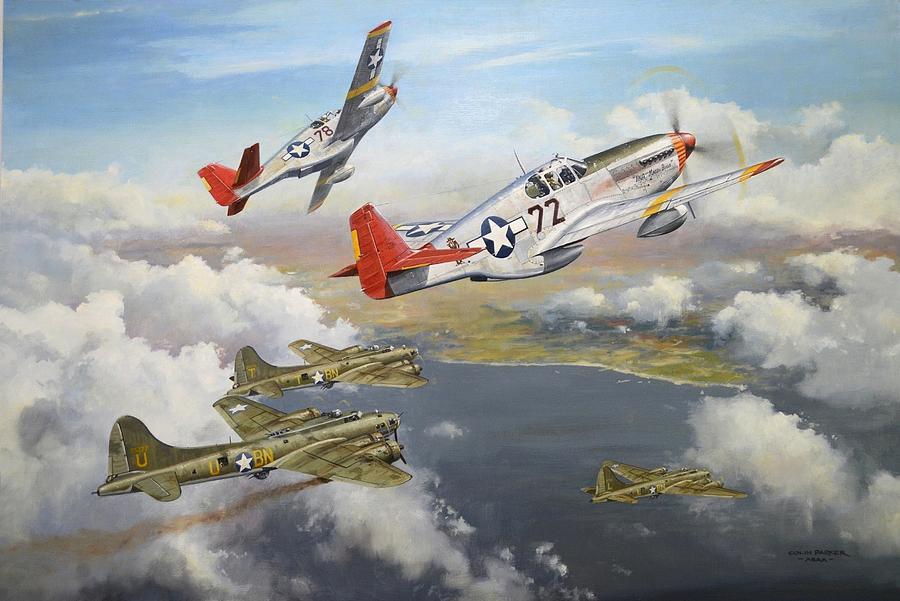

The Tuskegee Airmen were eventually deployed overseas, where they flew combat missions in North Africa and Europe. The most well-known unit, the 332nd Fighter Group, became famous for the distinctive red paint on the tails of their aircraft—earning them the nickname “Red Tails.”
Their primary mission was bomber escort.
American bombers flying over Europe were vulnerable to enemy fighters. Escort pilots were tasked with protecting these aircraft, often flying long, dangerous missions deep into hostile territory.
The Tuskegee Airmen developed a reputation for discipline and focus. Rather than chasing enemy planes to rack up kills, they stayed with the bombers, prioritizing protection over personal glory.
This approach worked.
Bomber crews began requesting the Red Tails specifically. Their presence increased confidence and improved mission success rates. Over time, the Tuskegee Airmen flew hundreds of missions, destroying enemy aircraft, strafing ground targets, and proving their effectiveness in combat.
 Breaking the Myth
The success of the Tuskegee Airmen directly challenged the racist assumptions that had limited their opportunities.
They demonstrated:
-
technical skill
-
strategic discipline
-
leadership under pressure
In doing so, they dismantled one of the central arguments used to justify segregation in the military.
Their achievements were not theoretical. They were measurable, visible, and undeniable.
Recognition—Slow and Incomplete
Despite their success, recognition did not come easily.
After the war, many Tuskegee Airmen returned home to a country that still enforced segregation. Their service did not shield them from discrimination. They had fought for a nation that was not yet willing to treat them as equals.
But change had begun.
In 1948, President Harry S. Truman signed Executive Order 9981, which desegregated the U.S. armed forces. The performance of the Tuskegee Airmen played a role in that decision, providing evidence that segregation weakened, rather than strengthened, the military.
 A Legacy That Extends Beyond the War
The Tuskegee Airmen did more than win battles in the air. They helped open doors.
Their success contributed to:
-
the integration of the U.S. military
-
expanded opportunities for Black service members
-
a broader shift in public perception
Many of the Airmen went on to distinguished careers in aviation, business, and public service. Their influence extended into the civil rights movement, where their example was often cited as proof of what had long been denied.
Why Their Story Still Matters
The story of the Tuskegee Airmen is not just about the past. It is about how systems change.
They did not begin with power. They began within a structure designed to limit them. What they had was skill, discipline, and the ability to perform under pressure when failure would have confirmed the worst expectations.
They succeeded anyway.
In doing so, they forced a reconsideration—not through argument alone, but through results.
The Enduring Image
Today, the image of the Tuskegee Airmen endures: pilots standing beside their aircraft, the red tails bright against the sky. It is a symbol not only of military achievement, but of persistence in the face of doubt.
They were not supposed to succeed.
That is what makes their story powerful.
They proved that the limitations placed upon them were never real to begin with—they were imposed. And once challenged, they could not hold.
Leave a comment
Comments will be approved before showing up.
Also in Time Capsule




Let customers speak for us
Gems
These short clips are gems. They are part of the history of music in America. Thank you for posting.
S. Kelley Chambers

Love the print and perfect decor for our n...
Love the print and perfect decor for our new apartment in Pittsburgh.
Chris P

5 stars review from Laura
5 stars review from Laura
Laura D

5 stars review from Geri
5 stars review from Geri
Geri L

5 stars review from Stephanie
5 stars review from Stephanie
Stephanie

5 stars review from Brookelynz
5 stars review from Brookelynz
Brookelynz
5 stars review from Deborah
5 stars review from Deborah
Deborah G

Spectacular!
Received as a gift and could not be happier with the quality of the print. Shipping container ensure this arrived in perfect condition.
John

5 stars review from Kayla
5 stars review from Kayla
Kayla G

5 stars review from Blondiee
5 stars review from Blondiee
Blondiee

5 stars review from April
5 stars review from April
April Y

5 stars review from Tracie
5 stars review from Tracie
Tracie C

Great quality and fast delivery!
Great quality and fast delivery!
Amanda C

5 stars review from Autumnrayne4
5 stars review from Autumnrayne4
Autumnrayne4

5 stars review from Traca
5 stars review from Traca
Traca B
